Dưới đây là bài báo chuẩn SEO bằng tiếng Anh (gồm đúng 50 câu) được sắp xếp thành các đoạn văn rõ ràng, mạch lạc và tối ưu hóa cấu trúc để người đọc dễ dàng theo dõi:
Engineering Failure Analysis: Lessons from a Dramatic Bridge Superstructure Collapse
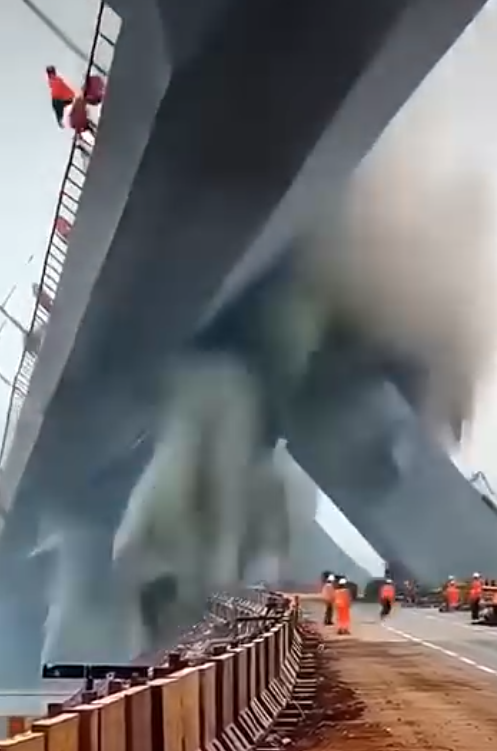
Infrastructure safety remains a paramount concern for civil engineers and construction managers worldwide. A recently circulated video clip, referencing the file named “296-11.mp4”, vividly illustrates the catastrophic dangers inherent to large-scale bridge construction and maintenance. The footage captures the shocking moment a massive concrete bridge span completely detaches and plummets into the water below. Initially, the scene shows a sprawling concrete bridge structure elevated high above a waterway under misty weather conditions. Construction equipment, including a large yellow crane, is positioned along an adjacent lower roadway or access pier. Several workers wearing orange safety vests and hard hats can be seen monitoring the engineering operation from a safe distance. Suddenly, a structural failure occurs at the junction where a major section of the upper bridge is supported. The massive concrete beam tilts violently as its supporting cables or structural joints instantly give way. Within seconds, the entire overhead concrete span shears completely off the main vertical support pillars. The heavy section accelerates downward, breaking apart into large debris fragments before striking the water.
The Immediate Aftermath and Public Reaction to the Structural Disappointment
As the bridge structure disintegrates, a colossal plume of dust and water vapor erupts into the air. Onlookers and construction workers can be heard shouting in utter panic and disbelief as the disaster unfolds. The violent impact generates massive waves that ripple outward across the body of water. Miraculously, the workers standing on the lower roadway appear to have avoided the direct path of the falling debris. The video cuts off shortly after the structure submerges, leaving a stark void where the bridge span once stood. This terrifying footage quickly garnered significant attention across international social media platforms and engineering forums. Viewers expressed deep concern regarding the safety protocols enforced during this specific engineering project. Industry experts immediately began debating the potential technical causes behind such a sudden structural collapse. Preliminary observations suggest that an unbalance or failure in the heavy-lifting mechanism might have initiated the failure. Incidents of this magnitude underscore the critical importance of rigorous stress testing and continuous structural monitoring.
Technical Insights into Bridge Construction Hazards and Failure Modes
Modern bridge engineering relies heavily on precise load calculations and strict material quality control. During the installation of precast concrete spans, structures are exceptionally vulnerable to minor alignment errors. If a crane or temporary gantry system shifts unexpectedly, it can introduce catastrophic torsional stress. Concrete possesses excellent compressive strength but can fail abruptly when subjected to unexpected tension or shearing forces. The collapse shown in the video highlights the extreme risks associated with high-altitude heavy lifting operations. Investigators analyzing such failures typically examine the integrity of the temporary rigging and anchoring systems. Additionally, environmental factors like high winds or hidden material fatigue can compromise temporary construction supports. When a critical component fails, a progressive collapse can trigger the destruction of the entire assembly. Learning from these documented engineering failures is essential for updating international building codes and safety regulations. Rigorous independent auditing of construction site practices can drastically reduce the occurrence of such industrial accidents.
Best Practices for Ensuring Workplace Safety on Large-scale Infrastructure Projects
Ensuring the safety of construction personnel must always be the top priority on any major civil engineering site. Comprehensive risk assessments should be conducted prior to executing any critical lift or structural adjustment. Workers must be trained to recognize early warning signs of structural distress, such as popping sounds or micro-cracking. Establishing clear exclusion zones beneath active lifting areas is vital to preventing fatalities during an unexpected collapse. Advanced digital modeling, such as Building Information Modeling (BIM), can simulate lifting stresses before physical execution. Real-time sensor technology can also be deployed to monitor load distribution on temporary support scaffolding. If any sensor detects an anomalous weight shift, automated alarms can signal an immediate evacuation of the site. Regular maintenance and certification of heavy machinery, like the cranes seen in the video, are legally mandated. Human error can be mitigated by enforcing strict communication protocols between crane operators and ground spotters. Adhering to these stringent safety frameworks ensures that complex engineering marvels do not transform into tragic disasters.
The Critical Role of Media Documentation in Enhancing Engineering Practices
Visual documentation of industrial accidents serves a purpose far beyond mere online sensationalism. Video recordings provide forensic engineers with invaluable real-time data regarding the mechanics of a collapse. By analyzing frame-by-frame progression, experts can pinpoint the exact origin point of a structural fracture. These real-world case studies are frequently integrated into university curricula to educate future civil engineers. Seeing the real-world consequences of mathematical miscalculations instills a profound sense of responsibility in students. Furthermore, public transparency regarding construction failures holds contracting companies accountable for their operational standards. When a video of a collapse goes viral, it often prompts government bodies to initiate thorough independent safety reviews. Ultimately, the lessons extracted from these unfortunate events contribute to the development of safer, more resilient infrastructure. The dramatic bridge collapse featured in the footage remains a sobering reminder of the forces of physics. As technology advances, the engineering community must continually strive toward achieving a zero-accident standard worldwide.