Chapter 1 – The Child Who Wouldn’t Forget
“Mama.”
Rosa Delgado flinched.
She had just set the folded towels on the counter, her hands moving automatically, muscle memory honed by years of cleaning other people’s homes with the quiet precision of someone who could not afford mistakes. The Whitmore estate was unusually silent that morning. No music. No footsteps. No voices drifting down the hall. Only the low whirr of the washing machine and the faint echo of the grandfather clock somewhere far away, counting seconds like a witness that never slept.
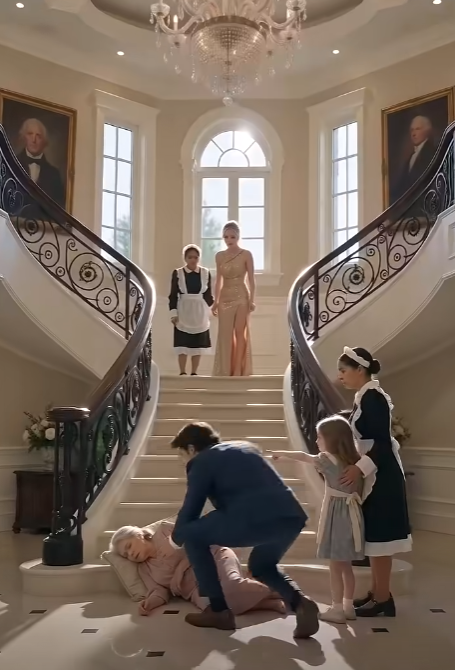
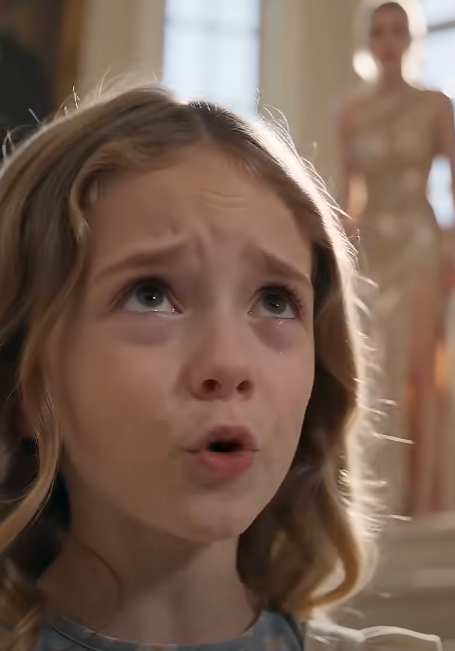

“Mama,” Lily said again, tugging harder at her sleeve.
Rosa looked down.
Her daughter stood too close to the doorway for comfort. Too still. Children were rarely still unless something had startled them or they were about to confess to breaking something valuable. Lily’s small hands were clenched around her wooden blocks, knuckles pale. Her dark eyes were wide and fixed not on Rosa’s face—but on the hallway beyond her shoulder.
“What is it, baby?” Rosa asked, keeping her voice low.
Lily swallowed. “The pretty lady did something bad.”
Rosa’s heart stuttered.
“What pretty lady?” she asked carefully, already knowing the answer.
“The one with the shiny rock,” Lily said. She lifted her own finger, mimicking a ring. “The one who smells like flowers.”
Vivien Cole.
Rosa’s mouth went dry. “Lily, you’re not supposed to be in the big house alone,” she said, forcing a smile. “You know that.”
“I wasn’t alone,” Lily replied. “I was hiding.”
The word hit Rosa like ice water.
“Hiding?” she echoed.
Lily nodded. “I wanted to play stairs. Mama says stairs are not toys. So I hid.”
Rosa closed her eyes for a brief second. Just long enough to picture the marble staircase—wide, polished, unforgiving. The same staircase where Mrs. Whitmore had fallen. The same staircase everyone in the house was pretending not to talk about.
“Hiding where?” Rosa asked.
“Behind the tall plant,” Lily said. “The one that scratches.”
The ficus by the landing.
Rosa felt dizzy. “What did you see, Lily?”
Lily hesitated. Her brow furrowed in concentration, like she was trying to remember the right order of things. “The grandma was walking slow. She was mad.”
Rosa’s chest tightened. Margaret Whitmore had always walked slow. Proud, upright, leaning on her cane like it was an insult rather than a necessity.
“And then?” Rosa prompted gently.
“The pretty lady was behind her,” Lily continued. “She was smiling but not nice-smiling.”
Rosa’s pulse thundered in her ears. “What do you mean?”
Lily searched for words. “Her mouth smiled. Her eyes didn’t.”
Children saw things adults learned to ignore.
“And then?” Rosa whispered.
Lily lifted one block and shoved it against the other, pushing hard. “She did this.”
Rosa grabbed Lily’s wrists. “No,” she said too sharply. Then she softened her grip, forcing her voice calm. “Baby, listen to Mama. You must not tell stories about people in this house. You understand?”
“I’m not telling stories,” Lily said, offended. “I saw it.”
Rosa looked down the hall again.
The kitchen doorway was empty, but that meant nothing in a house this large. Sound traveled strangely here. Secrets traveled faster.
“Lily,” Rosa said, lowering herself to her daughter’s height. “Did anyone see you?”
Lily shook her head. “The grandma saw me after. She looked at me.”
Rosa’s stomach dropped.
“What did she do?” Rosa asked.
“She tried to say something,” Lily said. “But then she closed her eyes.”
Rosa pulled Lily into her chest so hard the blocks clattered to the floor. Lily protested, squirming, but Rosa did not loosen her grip.
This was not a story.
This was not imagination.
This was memory.
And memory, once spoken, could ruin lives.
“Listen to me,” Rosa murmured into Lily’s hair. “You must never say this to anyone. Not ever. Do you hear me?”
“But Mama—”
“Never,” Rosa said, her voice breaking. “Not Daddy. Not Abuela. Not anyone. This is a grown-up problem.”
Lily went quiet.
Children understood fear better than adults liked to admit.
Footsteps echoed down the hall.
Rosa straightened instantly, smoothing Lily’s hair, forcing her face into neutrality just as Nathaniel Whitmore appeared in the doorway.
He looked like he hadn’t slept. His tie was loosened, his shirt wrinkled, dark circles shadowing his eyes. Power clung to him even in exhaustion, something heavy and controlled, like a storm waiting for permission.
“Rosa,” he said.
“Yes, sir,” she replied automatically.
His gaze dropped to Lily. “She shouldn’t be here.”
“I was just about to take her back to the east wing,” Rosa said quickly.
Nathaniel nodded, distracted. His eyes moved past them, scanning the hall, the walls, the space as if the house itself had betrayed him.
“She’s my responsibility,” Rosa added, too quickly.
“I know,” he said. “That’s not the problem.”
The silence stretched.
Nathaniel glanced at Lily again. She stared back at him with solemn curiosity, unblinking.
“Did you see anything yesterday?” he asked her.
Rosa’s heart stopped.
“No,” Lily said immediately.
Rosa exhaled in relief.
Nathaniel studied the child for a long moment. There was something unsettling about the way he looked at people when he was thinking—not judging, not accusing, just… measuring.
“All right,” he said finally. “Go with your mother.”
He stepped aside.
Rosa did not wait. She scooped Lily up and walked quickly toward the east wing, her steps measured, her face blank, her thoughts screaming.
They reached their small room and Rosa locked the door behind them.
Only then did she slide down against it, Lily still in her arms, her knees shaking.
“This house eats people,” Rosa whispered, more to herself than to her child.
Lily touched her cheek. “Mama’s crying.”
Rosa wiped her face roughly. “No, baby. Mama’s just tired.”
But she wasn’t tired.
She was terrified.
Vivien Cole stood alone in the upstairs bathroom, staring at her reflection.
She had already washed her hands twice.
Once to remove the phantom feeling of cold marble beneath her palms.
Once to remove the memory of Margaret Whitmore’s weight tipping forward, unexpected and heavy.
Vivien inhaled slowly, counting.
Three years. That was how long she had waited. Smiled. Endured. Let Margaret Whitmore inspect her like an item up for auction—her posture, her past, her bloodline, her worth.
“You’re pretty,” Margaret had once said, sipping her tea. “But pretty fades. What’s left when it does?”
Vivien had smiled then too.
Now she leaned closer to the mirror.
Her eyes were steady.
She had not panicked.
She had not screamed.
She had reacted.
Margaret had been a threat. An old one, yes—but old lions still bit.
Margaret had known. Vivien didn’t know how she knew, only that she had seen it in her eyes. That sharp, cutting assessment. That look that said I see you, and I will not allow you to take my son.
Vivien pressed her fingertips to the counter.
Everything she had was tied to Nathaniel. The engagement. The future. The life she had curated with surgical precision.
She would not lose it to a woman who still thought blood mattered more than choice.
There was a knock at the door.
Vivien straightened instantly.
“Nathaniel?” she called, softening her voice.
The door opened.
He looked at her like he didn’t quite recognize her.
“Why were you on the stairs with her?” he asked.
Vivien blinked. “I already told the paramedics.”
“I know,” he said. “I want to hear it again.”
She took a step toward him. He didn’t step back, but he didn’t lean in either.
“I was making sure she got to her room safely,” Vivien said. “She refused help. She always does.”
“She hates being helped,” Nathaniel agreed.
Vivien touched his arm. “She hates me helping her most.”
His jaw tightened.
“She said she didn’t fall,” he said.
Vivien’s expression softened into concern. “Nathaniel, she was in pain.”
“She said it twice.”
Vivien met his gaze steadily. “Are you accusing me of something?”
The question hung between them.
“No,” Nathaniel said slowly. “I’m listening.”
Vivien smiled, relieved, warm, perfect. She rested her head against his shoulder.
Nathaniel stood still.
Down the hall, in the east wing, a little girl sat on her bed clutching two wooden blocks, her brow furrowed in thought.
She pushed one block against the other again.
And again.
And again.
She would never forget the sound the old grandma made when she hit the bottom.
She would never forget the way the pretty lady’s smile disappeared before she pushed.