The red wine hit the waitress in front of four hundred charity guests.
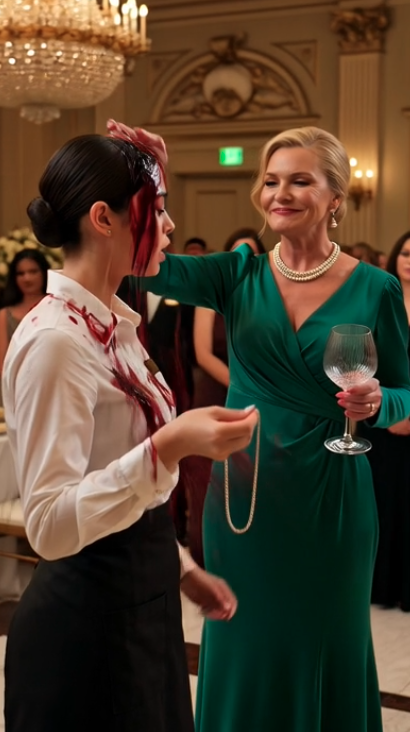
It splashed across her white shirt, ran down her apron, and dripped onto the marble floor beneath the crystal chandeliers.
The ballroom went silent.
A violin note died in the air.
The young waitress stood frozen with a diamond bracelet in her open palm.
Across from her, Victoria Langford lowered the empty glass with a satisfied smile.
She was one of the richest women in the room, wrapped in emerald silk, surrounded by donors who were too afraid of losing invitations to defend anyone beneath their social rank.
“Know your place. You’re just a servant.”
The waitress, Emma Caldwell, blinked wine from her lashes and held out the bracelet again.
“I was only returning your bracelet.”
Victoria looked at the diamonds, then at Emma’s soaked uniform.
Her mouth curled.
“People like you always steal first.”
Emma’s voice stayed quiet, but every camera near the gala stage picked it up.
“Then check the camera.”
The host signaled to the production booth.
A security clip appeared on the giant screen.
It showed Victoria dropping the bracelet near the auction table.
It showed Emma picking it up carefully.
It showed Emma searching the room, walking toward Victoria, and trying to return it.
The ballroom shifted from silence to shame.
Then the donor list loaded on the same screen for the final auction announcement.
At the top was the largest contribution of the night.
Caldwell Family Foundation.
Twenty-five million dollars.
The host looked at Emma, then at the list, then back at the guests.
“Her family funded this entire charity.”
Victoria’s face lost all color.
Emma stood in the center of the ballroom, soaked in wine, holding the bracelet that had exposed the truth.
Emma Caldwell had grown up hearing her father say that money reveals people faster than poverty ever could.
Her father, Robert Caldwell, had built Caldwell Medical Systems from a small pharmacy software company into one of the largest hospital technology firms in America.
He owned homes, private planes, and offices with views that made visitors speak softly.
But he never let Emma forget where the money began.
Her grandmother had cleaned hospital rooms in Cleveland.
Her grandfather had driven an ambulance until his hands shook too badly to hold the wheel.
Robert grew up doing homework in break rooms while nurses stepped over his backpack.
When he became wealthy, he gave quietly at first.
Scholarships.
Hospital bills.
Food programs.
Legal aid for families crushed by medical debt.
Then his wife died from a rare illness after months of treatment.
Her name was Grace.
She had one wish before she died.
She wanted Robert to build a charity that treated sick children, frightened parents, nurses, cleaners, and cafeteria workers as if they all belonged to the same human story.
The Grace Caldwell Children’s Fund was born from that wish.
Every year, the fund held one massive gala in Chicago.
The guests wore couture.
The auctions raised millions.
The cameras loved the glitter.
Emma hated the glitter.
Not because she hated wealth.
Because she saw how some people used charity as a mirror instead of a bridge.
They gave money while insulting valet drivers.
They posed with doctors but ignored janitors.
They wrote checks for sick children and snapped their fingers at the people carrying trays.
Emma had watched it for years from the donor table.
At twenty-four, she asked her father for permission to attend the next gala as a volunteer server.
Robert thought she was joking.
Emma said she wanted to know whether the fund her mother inspired still had her mother’s heart.
Robert studied his daughter across the breakfast table.
She had Grace’s eyes.
Gentle when loved.
Unforgiving when something innocent was harmed.
He agreed on one condition.
If anyone humiliated her, she would not hide the truth to protect anyone’s pride.
Emma promised.
The gala staff knew only that she was an extra volunteer from the foundation.
Her name tag said Emma.
No surname.
Her uniform was simple.
White shirt.
Black apron.
Flat shoes.
Hair tied back.
She arrived six hours before the doors opened.
She helped fold napkins.
She carried chairs.
She filled water glasses.
She learned which guests had allergies and which children from the hospital would appear in the closing video.
Most staff treated her warmly.
They thought she was a new volunteer with tired feet and a good smile.
Emma liked them immediately.
They worked harder than anyone who would be thanked on stage.
One woman named Rosa had been serving the Caldwell gala for eleven years.
She showed Emma how to balance six plates without shaking.
She also warned her about Victoria Langford.
Victoria was a board member’s wife, famous for large checks and small cruelties.
She had once made a bartender cry over an ice cube.
She had once accused a coat check attendant of hiding her mink wrap, only to discover she had left it in her own limousine.
She never apologized.
People excused her because her name appeared on donor walls.
Emma remembered that.
Names on walls meant nothing if the person behind them stepped on everyone below eye level.
The ballroom opened at seven.
Music filled the air.
Guests entered beneath floral arches.
Photographers flashed.
Emma moved quietly between tables with trays of sparkling water.
She watched people when they did not know they were watched.
Some smiled at the staff.
Some said thank you.
Some looked through workers as if service made them invisible.
Victoria arrived late, making sure heads turned.
Her emerald dress caught the chandelier light.
On her wrist was a diamond bracelet shaped like twisted vines.
She held her arm high enough for people to notice.
Emma served her table twice.
Victoria never said thank you.
During the silent auction, Victoria leaned over a display case to examine a signed baseball jersey.
Her bracelet slipped loose.
It landed on the carpet near the auction stand.
No one noticed.
Emma did.
She picked it up immediately and turned toward Victoria.
But the crowd shifted.
A photographer blocked her path.
Victoria moved toward the champagne tower.
Emma followed carefully, holding the bracelet flat in her palm so no one could accuse her of hiding it.
She reached Victoria near the center of the ballroom.
She lifted her hand to return it.
Victoria turned at the same moment.
For one second, she saw a waitress holding her diamonds.
Her face hardened before Emma could speak.
Emma began explaining.
Victoria did not listen.
She grabbed a glass of red wine from a passing tray.
Then she threw it.
The wine struck Emma’s face, chest, and apron.
Gasps moved through the crowd.
Someone laughed nervously.
Someone whispered that Victoria had gone too far.
But no one stepped in.
That silence told Emma more than the insult.
“Know your place. You’re just a servant.”
Emma held out the bracelet with wine dripping from her sleeve.
“I was only returning your bracelet.”
Victoria looked at the diamonds and made a show of stepping back.
“People like you always steal first.”
Emma’s father was standing behind the stage curtain at that moment, preparing to be introduced for the final donation announcement.
He saw the wine.
He saw his daughter.
His first instinct was to run forward.
Then he saw Emma straighten her shoulders.
He stopped.
Grace would have wanted him to let Emma speak.
“Then check the camera.”
The host, Marcus Reed, had known Emma since she was ten.
He looked toward Robert.
Robert gave one small nod.
Marcus signaled the production team.
The giant screen changed from auction totals to security footage.
Every face turned upward.
The camera showed the truth without emotion.
Victoria dropped the bracelet.
Emma picked it up.
Emma tried to return it.
Emma did exactly what an honest person would do.
Victoria stood beneath the screen watching her own cruelty replayed in front of donors, hospital directors, reporters, and the staff she had spent years insulting.
Her first mistake had been arrogance.
Her second was assuming the young woman in uniform had no one powerful behind her.
The production booth, confused by the interrupted schedule, advanced to the donor slide early.
The list appeared with bold gold letters.
At the top was the largest donation ever made to the Grace Caldwell Children’s Fund.
Caldwell Family Foundation.
Twenty-five million dollars.
Then the next line appeared.
In honor of Grace Caldwell and presented by her daughter, Emma Caldwell.
The room seemed to inhale at once.
Marcus lowered his microphone slightly, then spoke the truth everyone now understood.
“Her family funded this entire charity.”
Victoria looked at Emma again.
This time, she saw not a servant.
Not a thief.
Not someone she could shame without consequence.
She saw the daughter of the family whose money had paid for the gala, the hospital wing, the scholarships, the research grants, and the very stage on which Victoria had hoped to be admired.
Emma did not smile.
She wanted no satisfaction from Victoria’s fear.
She wanted everyone else to feel the shame of having waited until wealth protected her before they cared.
Rosa rushed forward with a clean towel.
Emma accepted it.
That was the first kindness anyone had offered in the room.
Robert stepped onto the stage.
He did not look at Victoria.
He looked at Emma.
His eyes were wet, but his voice stayed steady as he asked the staff to bring his daughter a chair.
Emma shook her head.
She walked to the stage on her own.
Wine stained every step of her white shirt.
The guests parted for her.
Some lowered their eyes.
Some tried to clap.
The applause died quickly because the room understood applause was too easy.
Marcus handed Emma the microphone.
She did not speak at first.
She looked at the doctors.
The board members.
The donors.
The servers standing along the walls.
The children’s hospital nurses seated near the back.
Then she placed Victoria’s bracelet on the podium.
Emma said charity that only respects people with money is not charity.
It is decoration.
She said her mother had not started the fund so wealthy guests could feel noble while humiliating workers.
She said every person carrying plates that night deserved the same dignity as every person writing checks.
Her voice trembled once when she mentioned Grace.
Then it grew stronger.
She announced that the Caldwell Family Foundation would still give the twenty-five million dollars.
But there would be conditions.
Every partner gala would adopt a dignity policy.
Any donor who abused staff, volunteers, patients, or families would be removed from events and barred from board roles.
A portion of the donation would create the Grace Caldwell Worker Scholarship for service workers and their children pursuing medical, hospitality, or social work careers.
Another portion would fund emergency grants for hospital cleaners, cafeteria workers, and support staff facing medical bills.
The ballroom remained silent.
This time, the silence felt different.
Not cowardice.
Recognition.
Victoria tried to move toward the stage.
Security stepped in.
She protested that she was a major donor.
Robert finally turned to her.
He said the fund did not need money that came with contempt.
Victoria looked around for allies.
No one stood.
Not her table.
Not the board member who owed her husband favors.
Not the women who had laughed at her jokes ten minutes earlier.
Security escorted her toward the doors.
Her emerald dress moved through the ballroom like a stain being removed from fabric.
She did not shout again.
Humiliation had taken her voice.
After she left, Emma invited Rosa and the serving staff onto the stage.
At first, they refused.
They thought it was not their place.
Emma told them that was exactly the lie the night had to end.
One by one, they stepped up.
Rosa.
Jamal from catering.
Lena from coat check.
Miguel from valet.
Nora from the kitchen.
People who had made the gala beautiful while others took credit for generosity.
The applause began again.
This time, it was not polite.
It was not for wealth.
It was for the people who had been invisible until the truth forced the room to see them.
The next morning, every local news outlet covered the incident.
Some headlines focused on the wine.
Some on the donor reveal.
Some on Victoria’s removal.
Emma disliked most of them.
They made the story sound like a rich girl in disguise getting revenge.
That was not the story she wanted told.
So she gave one interview.
She wore the same stained shirt.
She had refused to throw it away.
She said the point was not that Victoria insulted the wrong waitress.
The point was that no waitress should have been safe to insult.
That quote spread.
Not because it was clever.
Because it was true enough to make people uncomfortable.
Within a week, three board members resigned from the charity after staff complaints surfaced.
Old reports of donor misconduct were reviewed.
A hotline was created for event workers and hospital support staff.
Rosa became a paid advisor for the new dignity policy.
Emma insisted on it.
She also met privately with the hospital families supported by the fund.
A mother whose child had leukemia hugged her and said she had watched donors walk past cleaners for years.
A cafeteria worker cried when she learned the emergency grant program would include staff like her.
Emma realized the wine had exposed more than one woman’s cruelty.
It had exposed a culture that confused generosity with goodness.
Victoria tried to repair her image.
She issued a written apology through a publicist.
It used words like misunderstanding and emotional moment.
Emma read it once and placed it in a folder labeled performative.
Victoria later offered a private donation to regain her board influence.
Robert declined.
He said forgiveness was personal, but governance was responsibility.
The Langford name was removed from the annual honorary committee.
Not from the hospital donor wall, because the money had still helped patients.
Emma refused to rewrite history.
She only refused to let history buy future access.
Months later, Emma visited one of the worker scholarship recipients.
Her name was Lena, the coat check attendant who had watched the wine hit Emma and cried behind the curtain afterward.
Lena’s daughter had been accepted into nursing school but nearly deferred because tuition was short.
The Grace Caldwell Worker Scholarship covered the gap.
At the award ceremony, Lena brought Emma a small gift.
It was a white apron embroidered with one sentence.
Dignity is not a donation.
Emma framed it in the foundation office.
Two years passed.
The gala changed completely.
The next event was held in the same ballroom, but there were no VIP ropes.
Staff entered through the front doors.
Every donor table included hospital workers, nurses, service staff, and families who had received help.
The opening speech was not given by Robert.
It was given by Rosa.
She spoke about carrying trays for wealthy people who never looked at her face.
Then she spoke about her grandson using a scholarship to study pediatric nursing.
The room stood before she finished.
Emma stood with them.
She wore a simple black dress, no diamonds, and her mother’s small silver locket.
Robert watched from the side of the stage.
He thought of Grace.
He thought of their daughter standing in wine and refusing to bow.
He knew then that the fund had finally become what Grace had wanted.
Not a monument.
A living correction.
Years later, the wine-stained shirt became part of the Grace Caldwell Fund archive.
Emma placed it beside the first scholarship letters and her mother’s handwritten notes about dignity in care.
Students who toured the foundation often stopped in front of it.
Some laughed at first because the stain looked dramatic.
Then they read the plaque.
This shirt was stained on the night the fund remembered who it was for.
One afternoon, a young volunteer asked Emma whether she regretted serving as a waitress that night.
Emma looked through the office window at the hospital across the street.
She saw doctors in white coats.
Parents with tired faces.
Cleaners pushing carts.
A delivery driver unloading boxes.
A nurse holding the hand of a child in a wheelchair.
She shook her head.
She said she regretted that the lesson had required humiliation.
But she did not regret learning who would stay silent until a screen told them someone mattered.
The volunteer asked what happened to Victoria Langford.
Emma said she did not know much.
That was not entirely true.
Victoria had lost invitations, committee seats, and the circle that once protected her.
She eventually funded a small worker training program anonymously.
Maybe from shame.
Maybe from strategy.
Emma did not try to decide.
People can change, but no one owed them applause for beginning late.
The foundation continued.
The dignity policy spread to other charity galas.
Hotels requested training.
Hospitals adopted support staff emergency funds.
Event companies began including anti-abuse clauses in donor contracts.
One thrown glass of wine had forced wealthy rooms across the city to ask who they had been stepping over on the way to their own goodness.
On the tenth anniversary of the incident, Emma returned to the ballroom as chairwoman of the Caldwell Family Foundation.
Robert had retired.
Rosa sat in the front row.
Lena’s daughter, now a pediatric nurse, stood beside her.
The annual donor list appeared on the screen again.
This time, the top line was not one family’s name.
It was a collective fund made up of staff, patients, donors, workers, families, and companies.
Emma liked it better that way.
She stepped to the podium.
For a moment, she saw her younger self standing below the stage, soaked in wine, holding a bracelet that never belonged to her.
She also saw what came after.
Scholarships.
Policies.
Changed rooms.
People who learned to look service workers in the eye.
Emma touched her mother’s locket and smiled.
Then she began the gala with the words Grace Caldwell had written years before in a notebook Robert had almost lost.
Care begins with how we treat the person nearest to us.
She threw wine at the waitress.
Then the donor list exposed the truth.