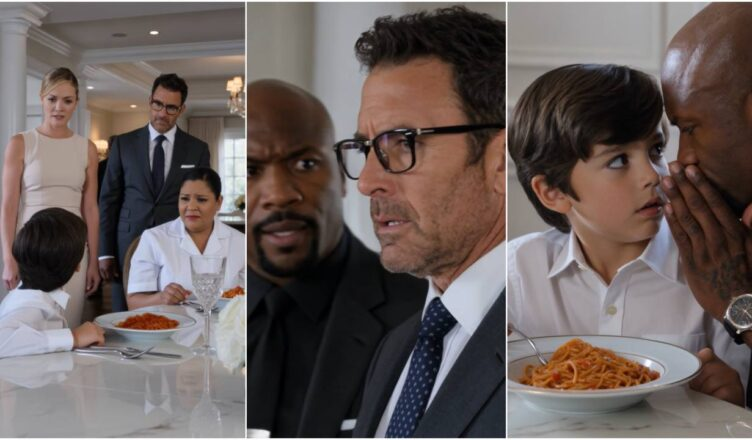
For three days, ten-year-old Theo Callahan had eaten almost nothing.
Not breakfast. Not dinner. Not the expensive lunches his mother ordered from private chefs. Not the pancakes shaped like animals, not the grilled chicken cut into strips, not the fruit arranged in perfect colors by the woman who had worked in their house since before Theo was born.
He sat at the long marble dining table in the Callahan estate outside Greenwich, Connecticut, with his arms folded across his chest, his medium-length black hair hanging into his eyes, his mouth pressed into a hard little line.
In front of him sat a plate of spaghetti in red sauce.
Untouched.
The dining room around him looked too beautiful for the scene unfolding inside it. Bright daylight poured through the tall windows. Crystal flowers stood in the center of the long table. A silver chandelier hung overhead. The marble floor reflected the light in cold, perfect sheets. Every surface looked polished, expensive, and controlled.
Everything was calm.
Everything except the child.
And everyone who had to live around him.
Rosa Alvarez sat beside Theo with tired kindness in her face. She was in her fifties, Latina, full-figured, wearing a simple house uniform, her dark hair streaked with gray and pinned neatly back. She had worked for the Callahans for years, long enough to remember when Theo would run into the kitchen barefoot and ask for pasta before breakfast.
“Just one bite, mijo,” Rosa said softly. “Then you can stop.”
Theo stared at the plate.
“I said I’m not eating.”
Behind the table, Andrew Callahan stood with one hand in his pocket, silent and distant behind his optical glasses. He was in his late forties, bearded, expensively dressed, a man powerful everywhere except inside his own house.
Beside him stood Meredith Callahan, beautiful, blonde, glamorous, her hair pulled back so tightly it made her already strained face look sharper. Her fitted clothes were flawless. Her expression was not.
“Theo,” Meredith said, voice trembling. “Please.”
He did not look at her.
Rosa picked up the fork.
“Maybe if I help—”
Theo moved before anyone could stop him.
He grabbed the plate with both hands and threw it directly into Rosa.
Spaghetti and red sauce slapped across her face, chest, and uniform. The plate clattered to the marble floor and spun once before settling beside the chair.
The room went dead silent.
Rosa froze with sauce dripping from her chin.
Then her face broke.
She burst into tears, covered her face with both hands, and ran from the table in humiliation, moving deep into the room and disappearing through the side hall.
Theo sat breathing hard, angry and pale.
Meredith turned on Andrew.
Not on Theo.
On Andrew.
Her eyes were wet, furious, almost wild with exhaustion.
“I can’t live like this. He’s unbearable.”
At the end of the sentence, she shoved Andrew hard in the chest.
He barely moved.
That made her cry harder.
She turned and ran from the dining room, one hand over her mouth, her footsteps fading down the hall.
Andrew stayed where he was.
Cold.
Blank.
Empty.
Near the entrance stood Darius King, the private security guard everyone in the house simply called King. He was Black, muscular, dressed in a dark fitted suit, tattooed hands folded in front of him. He had been hired eight months earlier after Andrew received threats during a legal fight over a hotel development.
King rarely spoke unless speaking mattered.
Now he stepped closer to Andrew.
“Sir… let me try”
Andrew did not turn his head.
He kept staring straight ahead at Theo with the exhausted expression of a father who had stopped expecting anything to work.
“Fine. Do whatever you want”
King nodded once.
He did not march toward Theo. He did not scold him. He did not raise his voice.
He walked to the sideboard, took a fresh plate of spaghetti with red sauce, and carried it to the table. Theo watched him with suspicion, still breathing through his anger.
King placed the plate in front of him.
Then he crouched beside Theo’s chair.
The boy glared at him, waiting for the threat, the lecture, the bribe, the adult performance he had learned to defeat before it began.
King leaned close to his ear.
His whisper was completely inaudible to everyone else.
Only Theo heard it.
The effect was immediate.
Theo turned his head and stared at King in shocked disbelief.
For one stunned beat, he did nothing.
Then he silently picked up the fork.
Andrew’s eyes narrowed.
Theo took a bite.
Then another.
Then another.
He ate as if hunger had been waiting beneath the rage the whole time.
King slowly turned his head toward Andrew.
Andrew finally looked at him, stunned.
King gave the smallest calm, knowing smile.
No one in that dining room understood yet that the whisper was not magic.
It was not fear.
It was not a threat.
It was the first time in months that someone had spoken to Theo in a language he understood.
Later, when Rosa had changed her uniform and Meredith had locked herself in the guest room to cry, Andrew called King into his study.
The room was dark wood, leather chairs, framed awards, and a wide window overlooking the circular driveway. Andrew closed the door behind them.
“What did you say to my son?”
King stood with his hands folded in front of him.
“I told him a boy who wants to steer my car has to prove he can control a fork first.”
Andrew stared at him.
“That’s it?”
“No, sir.”
Andrew waited.
King’s voice stayed respectful, but firm.
“I told him I knew he watches my Charger every time I park by the garage. I told him I knew he asked you twice if he could sit behind the wheel, and you said no both times without looking up from your phone.”
Andrew’s face tightened.
He remembered it then.
Two quick no’s.
Both delivered while walking into calls.
King continued.
“I told him if he ate, apologized to Rosa, and went seven days without throwing, insulting, or screaming at anyone in this house, he could sit on my knee Saturday morning and steer the car around the private backyard loop while I controlled the pedals. Slow. Safe. Earned.”
Andrew looked toward the window.
“You bribed him.”
“No, sir. I gave him something to earn.”
“My son threw food at a woman who loves him. My wife ran out crying. And you think the answer is a reward?”
“The answer is structure,” King said. “Rewards after good behavior. Consequences after bad behavior. Calm every time. Not begging. Not screaming. Not disappearing.”
Andrew turned back.
King did not soften the truth.
“Right now, this table is the only place your son has power. He refuses food, everyone reacts. He insults someone, the whole house stops breathing. He throws a plate, and his mother falls apart while you stand there like you’re watching a business deal go bad.”
Andrew’s jaw flexed.
“Careful.”
“Yes, sir.”
King stayed still.
Then he said, “But you asked.”
The study went quiet.
Andrew sat slowly behind his desk.
“I built all this for him.”
King looked around the room.
“No disrespect, Mr. Callahan, but children don’t know what to do with marble floors. They know who shows up.”
The words landed harder than anger would have.
Andrew looked down at his hands.
“He hates me.”
“No, sir. He’s waiting for you.”
Andrew gave a bitter laugh.
“That looked like waiting?”
“That looked like a boy checking whether anyone in this house is strong enough to stop him without leaving him.”
Andrew said nothing.
King continued.
“He needs rules. Clear ones. No throwing. No insults. No screaming at staff. Meals served once. If he chooses not to eat, the plate goes away until the next meal. No arguing for an hour. No negotiations.”
“And rewards?”
“Yes, sir. Earned rewards. Homework finished honestly, screen time. Five respectful school days, dinner with you. Seven days without insulting anyone, driving practice with me. Training hard, boxing lessons over the garage.”
Andrew frowned.
“Boxing?”
“He has too much anger and no place to put effort.”
“He’s ten.”
“That is exactly why someone should teach him control before the world teaches him consequences.”
Andrew leaned back.
“And what do I do?”
King looked at him directly.
“You come home.”
The room went still.
“You sit with him every night at seven. No phone. No assistant. No business calls. If he does homework, you stay. If he struggles, you stay. If he gets angry, you stay calm and you stay. When he does well, you say it. When he messes up, you correct him and stay.”
Andrew looked away.
“You make it sound simple.”
“No, sir. It’s not simple. It’s daily.”
The next morning, Andrew did something that surprised everyone.
He stayed home.
No driver waiting outside. No assistant trailing him with calls. No helicopter lifting from the lawn. He sat at the same marble table where Rosa had been humiliated and asked Meredith, Rosa, King, and Theo’s tutor to join him.
Theo came last, suspicious and barefoot.
Andrew had written the new rules on one sheet of paper.
No throwing.
No insults.
No screaming at staff.
Meals would be served once.
Respect was required before privileges were earned.
Apologies had to be specific.
Rosa would be treated as family, not furniture.
There was also an earned list.
Homework finished honestly meant thirty minutes of screen time.
Five respectful school days meant Friday dinner with Andrew anywhere Theo chose.
Seven days without insulting anyone meant Saturday driving practice on the private backyard loop with King controlling the car.
Training hard meant boxing lessons in the gym above the garage.
And every evening at seven, Andrew would sit with Theo for schoolwork.
No phone.
No business calls.
No interruptions.
Theo stared at the paper.
“This is stupid.”
Andrew nodded once.
“You’re allowed to think that.”
“I’m not doing it.”
“Then you’ll have a quiet week.”
“I hate this house.”
“You may hate the rules. You may not insult the people in it.”
Theo looked at Meredith, waiting for her to rescue him with emotion.
She did not.
She sat beside Andrew, pale but steady.
The first week was ugly.
Theo slammed doors. He refused lunch. He called the tutor boring. He told Rosa she was not his grandmother.
That cost him his tablet.
His first apology note to Rosa was three words.
Sorry. From Theo.
Andrew read it and handed it back.
“Again.”
Theo groaned.
“Why?”
“Because that is not an apology. That is a receipt.”
King, standing near the kitchen door, turned his face away so Theo would not see him almost smile.
The second note was better.
Dear Rosa,
I am sorry I threw spaghetti at you and embarrassed you. I was angry and wanted everyone to do what I wanted. You take care of me, and I treated you badly. I will not throw food again.
Theo
Rosa read it twice.
Then she looked at him.
“Thank you.”
Theo shifted on his feet.
“Are you still mad?”
“Yes,” Rosa said.
Theo looked surprised.
“But I still love you,” she added.
That confused him even more.
On Saturday morning, King was waiting by the black Charger behind the garage. The private loop curved around the back lawn, far from the road, bordered by hedges and old stone walls.
Andrew stood near the porch with his hands in his coat pockets.
Theo arrived at 5:54.
King glanced at his watch.
“Early.”
Theo tried not to smile.
King opened the driver’s door and sat down first. Theo climbed carefully onto his knee, both hands already reaching for the wheel.
“Listen,” King said. “You steer. I control the pedals. You do exactly what I say, exactly when I say it.”
Theo nodded fast.
“I mean it.”
“I know.”
King started the engine.
The car moved at walking speed.
Theo’s whole face changed.
Not with arrogance.
Not with rage.
With wonder.
He turned the wheel carefully while King’s hands hovered close, ready to correct. They made one slow circle around the yard. Then another. Andrew watched his son concentrate harder than he had concentrated on anything in months.
When the five minutes ended, Theo did not argue.
He climbed out, breathless.
“That was the best thing I ever did.”
King closed the door.
“Then remember what earned it.”
By the third week, Theo was training in the gym over the garage.
The first lesson had no gloves.
Only jumping rope, footwork, breathing, and learning how to stand without swinging at the air like a cartoon.
Theo hated it.
“This isn’t boxing.”
“This is the part before boxing.”
“It’s boring.”
“So is losing.”
Theo glared at him.
King pointed to the rope.
“Again.”
At school, the change came slower.
Theo had always hidden behind the word bored. Math was boring. Reading was boring. Teachers were boring. Andrew had believed too much of it because believing it was easier than admitting he had stopped paying attention.
So every night at seven, Andrew sat with him at the dining table.
At first, Theo complained.
Then he negotiated.
Then he tried silence.
Andrew stayed.
One night, Theo threw down his pencil.
“I can’t do this.”
Andrew looked at the worksheet.
“You can’t do it yet.”
“That’s the same thing.”
“No. It isn’t.”
Theo’s eyes filled with frustrated tears.
“You don’t even know how hard it is.”
Andrew almost corrected him.
Instead, he moved his chair closer.
“Then show me.”
Theo stared at him.
Then, reluctantly, he showed him.
They spent forty minutes on six math problems. At the end, Theo got four right.
Andrew wanted to make a speech.
He did not.
He just tapped the paper.
“Better.”
Theo tried not to smile.
Spring came slowly to the Callahan house.
Not cleanly.
Not magically.
Theo still had bad days. Meredith still cried sometimes, but now Andrew noticed before she had to say anything. Rosa began humming in the kitchen again. The tutors stopped leaving with tight mouths and silent eyes.
Andrew still answered too many emails at dinner until Theo once reached over, took the phone from his hand, and placed it facedown beside the bread basket.
“You said no interruptions.”
Andrew looked at him.
Then pushed the phone away.
“You’re right.”
That was how Meredith knew something had shifted.
Months later, Theo fought in his first youth boxing match at a small gym in Stamford.
It was not glamorous. Folding chairs. Bad coffee. Parents shouting too loudly. The air smelled like sweat and rubber mats.
Before the match, Theo stood in the corner with his gloves on, pale and scared.
“I can’t do it,” he whispered.
King crouched in front of him.
“You already did the hard part.”
“No, I didn’t.”
“Yes, you did. You showed up. You trained. You listened. Winning is extra.”
Theo swallowed.
“What if I lose?”
“Then you shake his hand and come back Monday.”
Theo looked past him at Andrew, standing near the ropes.
His father gave him one small nod.
Theo stepped into the ring.
He won by points.
When the referee raised his hand, Theo looked stunned. Then he looked straight at his father.
Andrew clapped until his palms hurt.
A week later, Andrew came home early and walked past the garage just as King was speaking with the older security guard, Luis.
They had not seen him.
King stood beside the Charger, wiping dust from the hood while Luis scrolled through his phone.
“You’re still looking at that Ram?” Luis asked.
King gave a quiet laugh.
“Every week.”
“Man, just buy it.”
“With what money?”
Luis turned the phone around. On the screen was a black Ram 1500, clean and powerful, the kind of truck that looked like it belonged on open roads.
King looked at it for a second too long.
“One day,” he said.
Luis smiled.
“How long?”
King shrugged.
“If nothing breaks, if Malik gets his scholarship, if overtime stays steady…” He paused, then laughed under his breath. “Maybe ten years.”
Luis shook his head.
“Ten years for a truck?”
King’s smile faded, but not sadly.
“For that one? Yeah.”
Andrew stood around the corner without moving.
For the first time, he understood something simple about the man who had helped save his house.
King had dreams too.
He just carried them quietly.
That night, dinner was waiting when everyone got home.
Nothing fancy.
Pasta.
Tomato sauce.
Salad.
Rosa placed the bowl in front of Theo and smiled.
He looked at it for a second.
Then he picked up his fork.
No drama.
No performance.
Just a hungry boy at the table.
After dinner, Andrew asked King to step outside.
A black Ram 1500 sat in the driveway with a red bow tied across the hood.
King stopped walking.
For several seconds, he said nothing.
Theo ran around the truck, unable to contain himself.
“It’s yours,” Theo said. “Dad got it for you. I helped pick the color.”
King looked at Andrew.
Andrew held out the keys.
“I know a bonus would have been simpler.”
King did not take them.
“Sir, I can’t accept that.”
“Yes, you can.”
“It’s too much.”
Andrew shook his head.
“No. What you gave this family was too much. This is a truck.”
King stared at the Ram.
Andrew lowered his voice.
“I heard you by the garage. You told Luis it would take ten years.”
King looked away, embarrassed.
Andrew stepped closer.
“My wife smiles at dinner again. My son looks people in the eye now. Rosa isn’t afraid of my dining room. I come home before dark. That started because you saw what I was too busy to see.”
King’s hand tightened around the keys.
“You didn’t fix my son,” Andrew said. “You made me understand I had stopped showing up.”
For once, King had no answer.
Theo shouted from beside the truck.
“Start it!”
King laughed, deep and surprised.
He climbed in, closed the door, and turned the key.
The engine came alive, low and strong, rolling across the driveway.
Theo cheered.
Andrew stood on the front steps beside Meredith. After a moment, she slipped her hand into his.
Inside, dinner plates waited in the sink.
On the table, beside Theo’s empty bowl, one last strand of spaghetti curled against the white porcelain.