The Girl Under the Chandeliers
The charity gala at the Aster House Hotel in Boston had the kind of beauty that made people lower their voices without realizing it.
Crystal chandeliers floated above the ballroom like frozen fireworks. Warm gold light spilled across polished marble floors, silk gowns, black tuxedos, champagne flutes, and old Boston families who seemed to treat generosity like a social season. A jazz quartet played beneath a balcony trimmed in gold, soft enough not to interrupt the donors congratulating one another for caring in public.
Mara Ellis moved through them like a shadow.
She wore the hotel’s black service dress with a white apron tied neatly at her waist. Her dark hair was pinned low at the back of her neck. Her makeup was natural, almost invisible, enough to make her look rested when she was not. Her face stayed calm in the way hotel staff were trained to look when rich people spoke over them, through them, or not to them at all.
Invisible.
That was the point.
For almost eight years, Mara had survived by becoming forgettable.
Before Boston, she had been a hostess in Denver. Before that, a hotel cleaner in Portland. Before that, a night-shift waitress outside Albany who paid cash for her room and never stayed anywhere longer than the lease required. Different cities. Different names. No photographs. No social media. No friends close enough to ask where she learned three languages, why she never drank, or why she always sat facing doors.
Boston was supposed to be temporary.
Everything was temporary.
“Champagne?” she asked, stopping beside a cluster of donors near the marble staircase.
A man took a glass without looking at her.
Another said, “Thanks, sweetheart,” in the distracted voice of someone accepting a napkin.
Mara lowered her eyes and moved on.
At the center of the ballroom, Grant Whitaker stood beneath the largest chandelier, surrounded by applause, cameras, and people who needed to be seen near him. At forty-six, Grant had the relaxed confidence of a man who had made too much money too young and learned to pretend he didn’t enjoy it. His medical technology company had just funded a major international hospital initiative, and tonight’s gala was partly charity, partly politics, and partly a quiet negotiation between people who never called anything a deal until the papers were signed.
Mara had seen his face on magazine covers in the hotel lobby.
In person, he looked sharper. More tired. Less impressed by the room than everyone around him seemed to be.
She kept her distance.
The guest list had changed that afternoon. Mara had seen the updated names on a clipboard in the service hall less than twenty minutes before doors opened.
Karsovan trade delegation.
The words had made her fingers go cold.
Karsova was a country most Americans barely remembered unless there was a coup, a border crisis, or an investment opportunity. To Mara, it was not a country. It was burning gates. Marble stairs slick with rain. Her mother’s hand closing around the back of her neck. A tunnel that smelled like stone, smoke, and wet wool.
She should have left the hotel immediately.
She almost did.
But by the time she saw the list, the ballroom doors were already open, the service corridors were crowded, and the delegation had arrived through the private entrance. Two men in dark suits were posted near the rear hallway, not hotel security, not staff, and not looking at the guests. Looking at exits.
Mara understood the shape of danger when she saw it.
Running through a lobby full of cameras would make her visible. Disappearing from the staff line five minutes after the Karsovan delegation arrived would make her memorable. So she did what fear had taught her to do.
She kept her head down.
She became part of the room.
The pendant at her throat was the one mistake.
She should never have worn it.
But she had worn it every day since she was sixteen years old, since the night her mother pressed it into her palm and whispered, Do not speak your name unless you are ready for the world to hear it.
A crescent wrapped around a mountain star.
The symbol of a dead house.
The last thing Queen Helena had given her daughter.
Mara was refilling a tray near the stage when she felt it.
A stare.
Not the usual kind. Not a guest deciding whether she was worth flirting with. Not a manager checking her posture. This stare found her like a hand closing around her throat.
She looked up.
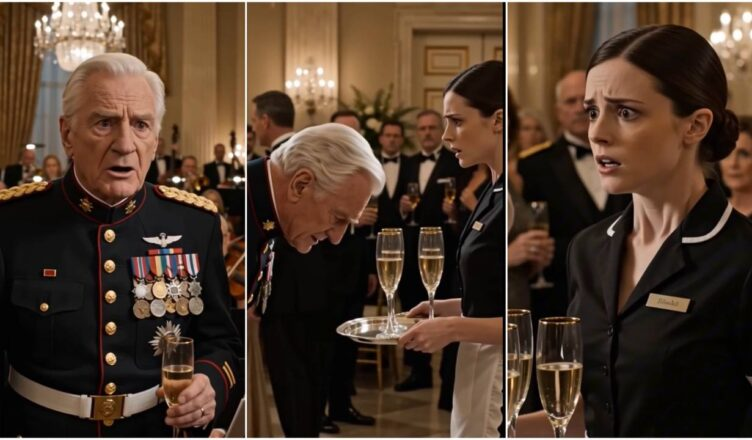
Near the orchestra stood an elderly man in a dark formal military dress jacket heavy with medals. He was tall, rigid, around seventy, with white hair combed back and a stern lined face that looked as if it had survived more than one government. A champagne glass trembled in his hand.
His eyes were fixed on Mara.
The room seemed to contract.
Mara knew him.
Not instantly with her mind, but with her body. The military posture. The old scar near his left eyebrow. The grief in his eyes before he had even understood what he was seeing.
General Stefan Vasko.
Her father’s chief of guard.
The man who had pulled her through the east wing tunnel when the palace fell.
Eight years had passed, not sixteen. Long enough to turn a terrified teenage princess into a guarded young woman, but not long enough to erase her face from the memory of the man who had carried her bleeding through smoke.
Mara stopped breathing.
The jazz continued for another second, soft and elegant and absurd.
Then Vasko took one step toward her.
“My God…” he whispered, so quietly only the nearest guests heard. “It’s her.”
A woman beside him turned. “General?”
He did not answer.
Mara’s fingers tightened around the tray.
No.
She willed the word silently.
No, no, no.
But Vasko was already walking toward her.
He moved with the slow certainty of a man approaching a grave that had opened. Mara stood frozen among the chandeliers, a slim young waitress with a tray of champagne in her hands and nowhere to run without making every head turn faster.
He stopped directly in front of her.
His eyes were wet now.
For one unbearable second, he simply looked at her face. The shape of her eyes. The small scar near her left brow, almost hidden by makeup. The pendant where her collar had shifted just enough for the silver to catch the chandelier light.
Then the old general bowed.
Deeply.
Formally.
From the waist.
Not a polite bow. Not theater. A bow given to a sovereign, a ghost, and a child he had failed to protect all at once.
“Your Highness,” he said.
The music faltered.
A saxophone note died in the air. Conversations collapsed in little circles. A few guests turned first with curiosity, then discomfort, then the sharp hunger people got when they sensed scandal entering a room in human form.
Mara’s tray trembled slightly in her hands. The champagne flutes rattled against the silver.
She stared at Vasko, panic rising behind her controlled face.
“Please don’t,” she said, her voice quiet and urgent. “Not here.”
The ballroom went still.
Grant Whitaker, watching from beneath the chandelier, saw the moment change before he understood it. He saw the old general bowed in front of a waitress. He saw Mara’s face go white. He saw the donors begin to turn with their polite smiles falling away.
Then he started moving toward them.
Nolan Pierce, a venture capitalist with a red face and a diamond watch, got there first. He had been drinking since the silent auction and had the kind of confidence that mistook cruelty for wit.
“I’m sorry,” Nolan said loudly, looking around for an audience. “Did he just bow to the help?”
A few nervous laughs flickered and died.
Vasko straightened slowly.
The look he gave Nolan was not loud, but it silenced him.
“This woman is not the help,” Vasko said.
Mara’s eyes flashed with warning.
Too late.
Vasko turned toward the gathering guests, his voice still rough with shock.
“She is Princess Amara Helena Vey of Karsova.”
The silence spread across the ballroom like spilled ink.
Someone whispered, “Karsova?”
Another voice said, “The royal family?”
Mara closed her eyes.
There it was.
The name she had spent eight years burying.
Grant pushed through the growing circle, his expression controlled but alert. “What’s going on?”
Nolan pointed at Mara with a glassy grin, trying to reclaim the room. “Apparently your waitress is royalty.”
Mara looked at Grant. “This is a mistake.”
Vasko shook his head. “No. I served your father for twenty-seven years. I escorted you out of the east wing when you were sixteen. You had blood on your sleeve, and you would not let go of your mother’s necklace.”
Mara’s hand flew to her throat.
The movement exposed the pendant fully.
A crescent wrapped around a mountain star, worn smooth at the edges from years beneath clothing and frightened fingers.
Vasko’s face crumpled.
Grant saw it too. Something changed in his expression—not belief yet, but attention.
“Where did you get that?” he asked.
Mara covered the pendant with her palm. “It belonged to my mother.”
“What was her name?”
Mara looked away.
Vasko answered for her.
“Queen Helena.”
A woman gasped.
The name carried enough history that even the people who did not know details understood it mattered. Eight years earlier, every major news channel had shown the burning gates of the Royal Palace in Karsova. The official announcement came two days later: King Adrian Vey, Queen Helena, and their only daughter, Princess Amara, had died during the military coup that brought General Radomir’s regime to power.
The story had been tragic, clean, and useful.
Too useful.
Rumors had survived for years.
A daughter smuggled out.
A bloodline hidden.
A princess who vanished into America.
Nolan rolled his eyes, though his voice had lost some of its force. “A necklace doesn’t prove anything.”
“No,” Vasko said.
He reached into the inside pocket of his jacket and removed a worn leather wallet. From it, he took a photograph so old the edges had softened.
He handed it to Grant.
The picture showed a royal family standing on palace steps: a dark-haired king in formal uniform, a queen with kind eyes, and a teenage girl in a white dress holding her mother’s hand. Around the girl’s neck was the same silver pendant.
Grant looked from the photograph to Mara.
Same eyes.
Same mouth.
Same scar near the brow.
Mara swallowed hard.
“General Vasko,” she said softly.
At the sound of his name in her voice, the old man’s composure broke again. He bowed his head, lower this time, almost in shame.
“My God,” he whispered. “It is you.”
The tray tilted in Mara’s hands.
Grant reached out instinctively and steadied it before the glasses could fall.
Their eyes met.
For the first time that night, someone looked at her not as staff, not as a curiosity, not as a myth dragged out of old news—but as a person trying very hard not to fall apart.
“You need to leave this room,” Grant said quietly.
Fear came back into Mara’s face fast.
“You don’t understand.”
“I understand enough.”
“No.” Her voice dropped. “If he recognized me, somebody else will.”
As if the words had summoned them, Mara saw movement near the west entrance.
Two men in dark suits had shifted away from the doorway. They were not rushing. That was what made them frightening. They moved with professional calm, speaking into cuffs, scanning sight lines, quietly cutting off the most obvious exit without alarming the guests.
At the far end of the ballroom, a third man waited beside the service corridor.
Mara had seen his photograph in one of Vasko’s old warning files years ago.
Colonel Ilya Dragan.
Officially, he was part of the Karsovan trade delegation’s diplomatic security team.
Unofficially, he had signed the detention orders that made dissidents disappear.
He looked directly at Mara.
He did not smile.
He simply reached into his jacket, removed a phone, and took one picture.
Confirmation.
Vasko saw him too.
His face hardened.
“Mara,” he said, low and urgent. “Behind me.”
Grant looked toward the doors. “Who are they?”
Mara backed one step away from the open floor. Her lips barely moved.
“The men who made sure my family stayed dead.”
Grant did not waste time asking for proof.
He turned slightly, enough to signal one of his own event-security coordinators near the wall. The man caught his eye and stiffened. Grant lifted two fingers, then touched his cuff.
A silent protocol.
Not magic. Not a panic button that summoned an army out of nowhere.
A system.
Six months earlier, after threats against another international medical event, Grant’s foundation had required the Aster House to install a quiet emergency procedure for high-profile guests: doors monitored, staff corridors checked, police liaison notified, hotel security switched to internal channel, no public alarms unless necessary.
Grant had hated paying for it.
Tonight, it became the difference between chaos and control.
“Stay calm,” he said to Mara.
“That won’t help.”
“It keeps people from getting trampled.”
Dragan and the two men did not charge across the ballroom. They did something worse.
They became polite.
One of them approached hotel security with a diplomatic credential already in hand. Another moved toward the service corridor where staff came and went. Dragan walked straight toward Grant’s circle with the smooth, contained authority of a man who expected Americans to hesitate before making an international incident.
“Mr. Whitaker,” Dragan said, his accent light but clear. “There appears to be confusion involving a member of your staff. We can handle it privately.”
Mara went very still.
Vasko stepped between them.
“You will not come near her.”
Dragan’s eyes flicked to him.
“General Vasko,” he said. “Still chasing ghosts?”
“No,” Vasko replied. “Standing in front of one.”
The guests closest to them had gone silent. Phones were beginning to rise, but cautiously. Wealthy people knew how to document scandal while pretending they were above it.
Grant kept his voice low. “This is a private event. Hotel security will handle any issue involving staff.”
Dragan smiled faintly. “With respect, this is a diplomatic matter.”
“No,” Grant said. “This is a woman being surrounded by men who have not identified themselves to her.”
Dragan’s expression cooled.
The man by the service corridor lifted his hand slightly. Not a weapon. A signal.
Mara saw two hotel staff members step aside as if unsure whether they were allowed to block him.
Grant noticed too.
He moved closer to Mara without touching her. “There’s a staff exit behind the stage. Walk, don’t run.”
“They’ll follow.”
“That’s why we walk before they decide they can.”
Mara looked at Vasko.
The old general nodded once.
“Go.”
Grant guided Mara through the nearest break in the crowd. He did not grab her wrist. He did not drag her. He kept half a step behind her, using his body and status to create space without making the ballroom panic.
Behind them, Vasko stayed where he was, blocking Dragan’s line of sight.
Nolan, drunk and suddenly thrilled to be near something dangerous, said, “Is this some kind of performance?”
Vasko turned his head slowly.
Nolan shut up.
Mara and Grant passed behind the jazz quartet just as the music stopped completely. Guests were murmuring now. Not screaming. Not yet. Confusion moved through the room faster than fear.
At the service door, one of Dragan’s men appeared from the side corridor.
He wore a polite smile and held one hand out as if to guide her.
“Miss Ellis,” he said. “This way, please.”
Mara stopped.
Grant stepped forward. “She’s with me.”
The man’s smile did not change. “Sir, this does not concern you.”
Grant looked past him toward the kitchen corridor. Two hotel security officers were moving in from the opposite end, not running, but fast.
“It does now,” Grant said.
For one second, the man weighed his options.
That was when Mara understood how close she was to being taken.
Not by a dramatic attack.
Not by a gun in a ballroom.
By a hand on her arm, a polite escort through a staff corridor, a black SUV in a loading bay, and a statement tomorrow morning calling the entire incident a misunderstanding.
The man reached for her elbow.
Grant caught his wrist.
Not violently. Firmly.
“Don’t,” Grant said.
The hotel security officers closed in.
The man released his hand and stepped back immediately, returning to innocence before any guest could process what had happened.
“Misunderstanding,” he said.
“Then you won’t mind staying where you are,” Grant replied.
Security separated him from the door.
Grant pushed the service door open.
Mara went through.
The hotel kitchen was bright, loud, and hot. Cooks and servers froze at the sight of Grant Whitaker entering with a pale waitress and two security officers behind him.
“Keep moving,” Grant said.
Mara’s breath was shallow. “They know the service routes.”
“So does hotel security.”
They moved through a narrow staff corridor lined with carts, linen racks, and stainless-steel shelves. Nobody ran. Running would have spread panic. Grant kept speaking quietly into his phone, not making a call, but staying connected to the hotel’s internal emergency line.
“Loading dock closed?” he asked.
A pause.
“Good. Lock the east stairwell. No, don’t touch the diplomatic party unless they force it. Just hold positions and wait for Boston PD.”
Mara glanced at him.
“You’ve done this before?”
“No. I paid people who have.”
That answer was more believable than bravery.
They turned into a small service office used by banquet managers. A desk, two monitors, a coffee machine, a wall of radios charging in plastic slots. One security officer closed the door behind them. The other stood outside.
Grant locked the door.
For the first time since Vasko bowed, Mara’s knees nearly gave out.
She caught herself against the desk.
“I shouldn’t have come here.”
“You work here,” Grant said.
“I saw the delegation list.”
“When?”
“Twenty minutes before doors opened.”
He understood. “Too late to leave without being noticed.”
She nodded, breathing hard.
Outside the office, footsteps passed. A radio crackled.
Grant lowered his voice. “Tell me what I need to know.”
Mara stared at him.
“Why are you helping me?”
“Because three men tried to quietly remove a waitress from my event after an exiled general called her Your Highness.” He gave a short, humorless breath. “That’s not the kind of coincidence I ignore.”
She looked away.
“I was sixteen,” she said. “There was a coup. My father refused to sign the emergency decree. My mother hid me in the east wing. Vasko got me through the old tunnels under the palace chapel. After that, families took me in. Good people. Scared people. Every year, somebody got too curious, or a name surfaced, or a photograph came too close. So I ran.”
Grant listened without interrupting.
Mara touched the pendant at her throat.
“My mother told me not to speak my name unless I was ready for the world to hear it.”
“And are you?”
Her laugh came out brittle.
“No.”
The office phone rang.
Grant picked it up. “Whitaker.”
He listened.
His expression changed, not with surprise, but confirmation.
“Send them to the service office. Quietly.”
He hung up.
“Boston police are in the building,” he said. “Federal agents are three minutes out. Vasko had already contacted someone at the State Department before tonight. He suspected the delegation might be here for more than trade.”
Mara stared at him. “He knew?”
“He didn’t know about you. But he knew about Dragan.”
The door opened after a coded knock.
General Vasko stepped inside with a hotel security supervisor and a plainclothes Boston detective. His military jacket was still perfect, but his face looked ten years older than it had in the ballroom.
When he saw Mara unharmed, his breath left him.
“Your Highness.”
Mara closed her eyes. “Please.”
Vasko stopped himself.
“Mara,” he said instead, and the name looked painful in his mouth.
The detective introduced herself quickly. “Detective Harris. We’re securing the exits. No one is leaving the building until we sort out who belongs to which detail.”
Grant pointed toward the ballroom feed on the office monitor.
“Dragan?”
The security supervisor switched cameras.
The ballroom appeared in muted surveillance footage. Guests clustered in nervous groups. Hotel security had formed a polite but firm boundary near the main doors. Dragan stood beside the Karsovan trade minister, speaking calmly to a uniformed officer.
Mara watched him and felt the old fear return.
“He’ll claim diplomatic immunity.”
“He can claim whatever he wants,” Detective Harris said. “He’s not moving you through a loading dock tonight.”
Vasko stepped closer to the monitor.
“Dragan signed the execution list,” he said.
The office went still.
Mara turned toward him.
Vasko looked at her with grief in every line of his face. “I have copies. I came tonight because I believed he was using the trade delegation to pressure American investors. I did not know you were alive. If I had known—”
“You got me out,” Mara said softly.
“I lost you.”
“You got me out first.”
The detective’s radio crackled.
“Possible movement at the east service elevator,” a voice said. “Two males, black suits, refusing to identify.”
Detective Harris touched her earpiece. “Hold them. Do not escalate unless they do.”
Grant looked at Mara. “Stay here.”
“No.”
Every face turned toward her.
Mara’s voice shook, but she kept going.
“If they’re stopped in a hallway, this becomes another quiet incident. A misunderstanding. Diplomatic confusion. If I stay hidden in a back office, they still get to decide what I am.”
Vasko looked stricken. “Mara—”
“My mother told me not to speak my name until I was ready,” she said. “Maybe ready isn’t a feeling.”
Grant studied her.
“What do you want to do?”
She looked at the surveillance monitor. At Dragan standing under chandeliers as if history had never laid a hand on him.
Then she touched the pendant.
“I want cameras.”
Grant nodded once.
“There are plenty of those in the ballroom.”
They returned not through the center of the gala, but through the side entrance near the stage, with Boston police and hotel security already positioned discreetly around the room. The jazz quartet had stopped playing. Guests had formed a wide, nervous circle around the main floor. No one was pretending anymore.
Dragan turned when Mara entered.
For the first time, his composure cracked.
Not fear exactly.
Recognition that the private problem had become public.
Mara walked into the open space beneath the chandelier.
Vasko stood to her left.
Grant to her right.
Detective Harris remained a few steps behind, careful not to turn the moment into theater but close enough to act.
The Karsovan trade minister forced a smile. “This is highly inappropriate.”
Mara looked at him.
“No,” she said. “What happened eight years ago was inappropriate.”
The room fell silent.
Phones rose openly now.
Mara did not stop them.
Her voice was quiet at first, but it carried.
“My name is Amara Helena Vey. Daughter of King Adrian and Queen Helena of Karsova. The official report said I died in the east wing during the coup. That report was false.”
Dragan stepped forward.
Detective Harris moved half a pace.
He stopped.
Mara kept her eyes on the room.
“My father was murdered because he refused to sign away the constitution. My mother was murdered because she tried to get me out. General Vasko saved my life. I have lived under false names for eight years because the men who took my country needed the world to believe my family was gone.”
The trade minister said sharply, “This woman is unstable.”
Vasko’s voice cut across the room.
“I carried her from the palace myself.”
The trade minister turned on him. “You are a traitor.”
“No,” Vasko said. “I am late.”
That silence struck harder than any accusation.
Grant looked toward the nearest camera phone, then to Mara.
She understood.
She lifted the pendant from her throat so the room could see it.
“My mother gave me this before she died,” she said. “She told me not to speak my name unless I was ready for the world to hear it.”
Her eyes found Dragan.
“I am ready.”
A burst of movement near the east entrance drew everyone’s attention. One of Dragan’s men tried to push past hotel security, not attacking, not shouting, but forcing the kind of confusion professionals used to create an opening.
Boston police closed around him immediately.
Another plainclothes officer took his arm.
No screams. No stampede.
Just a controlled, public failure.
Dragan watched it happen, and hatred moved openly across his face.
Mara did not look away from him.
“You should have stayed a ghost,” he said, low enough that only those closest heard.
Grant stepped forward.
But Mara raised one hand.
“No,” she said.
Then, clearly enough for the nearest phones to catch it, she repeated his words.
“He just said I should have stayed a ghost.”
Dragan realized the mistake too late.
Detective Harris turned to the officers near him. “Detain him.”
The trade minister erupted. “You cannot detain diplomatic security.”
Detective Harris did not raise her voice. “We can detain a man interfering with a protected witness in an active investigation.”
Two officers moved in.
Dragan did not fight. That would have been too easy to condemn. He held his dignity like armor while they took his phone, secured his hands, and led him away through a corridor lined with stunned donors.
The ballroom remained silent long after he was gone.
Mara stood beneath the chandeliers, trembling now that the immediate danger had passed.
Vasko turned toward her.
For a moment, the old instinct overtook him. He began to bow again.
This time, Mara reached out and placed one shaking hand on his shoulder before he could lower himself.
“Don’t,” she said softly. “Not tonight.”
Vasko looked up, eyes wet.
“What should I call you?”
Mara looked around the ballroom—the marble, the guests, the phones, the police, the men who had thought another quiet disappearance could still be arranged if it was done politely enough.
Then she touched the silver pendant at her throat.
“My name,” she said.
By sunrise, every screen in the world showed the same image: a young hotel server in a black uniform standing under the chandeliers of the Aster House, no crown, no palace, no guards of her own.
Only her mother’s necklace.
And a name history had failed to bury.
The next forty-eight hours moved like a storm.
The Karsovan embassy denied everything first. Then it called the footage a fabrication. Then it blamed “foreign destabilization efforts.” By the third statement, no one believed them. The ballroom had been full of cameras, witnesses, police reports, hotel security logs, and one exiled general who had spent eight years keeping copies of documents in separate countries.
General Vasko gave sworn testimony before federal investigators. He had lived in exile in Canada under a different name, carrying palace evacuation routes, communications logs, and the names of officers who betrayed King Adrian. He had come to Boston because Dragan was traveling with the trade delegation, and Vasko believed he could finally connect the current regime to the killings that began the coup.
He had not known Amara would be there.
That, he told investigators, was either fate or the last mercy of God.
Mara hated the cameras.
She hated the way strangers said princess as if it explained her. She hated that people suddenly cared about the dead because the living had become useful. She hated most of all that everyone wanted her grief to look graceful.
Grant kept the press away from her as much as he could. Not with speeches, not with ownership, but with doors, lawyers, security, and silence.
For two days, she stayed in a private suite at the Aster House under federal protection. She slept badly. Ate almost nothing. Sat by the window with her mother’s pendant in her palm and watched news vans multiply outside.
On the third night, Vasko visited her.
He stood just inside the suite, formal even without the ballroom around him.
“I failed your father,” he said.
Mara looked up from the window seat.
“You saved me.”
“I was ordered to save the crown.”
“No,” she said quietly. “You saved a girl.”
The old general’s face tightened.
For years he had carried the version of the story that punished him most: the king dead, the queen dead, the princess hidden and lost, the kingdom swallowed by men in uniforms who called murder transition. He had imagined finding Amara a thousand times. He had imagined kneeling, apologizing, asking permission to spend whatever remained of his life repairing what he could.
He had not imagined her looking at him with mercy.
“I remember the tunnel,” Mara said. “I remember you carrying me.”
Vasko bowed his head.
“You kept asking for your mother.”
“I still do.”
The sentence broke something in him.
He wept then, silently, standing in the center of a luxury hotel suite with his hands folded in front of him like a soldier awaiting judgment.
Mara crossed the room and took his hand.
Neither of them spoke for a long time.
A week later, the first wave of documents reached the international press.
The official death report for Princess Amara had been signed before the east wing was fully searched. The rebel communications logs referred to “the girl” as missing for thirty-six hours after the palace fell. A sealed diplomatic memo showed that at least two foreign governments had suspected she survived but chose stability over inquiry. Bank records connected senior Karsovan officials to offshore payments made to men who had trailed dissidents across Europe and North America.
The myth of a clean transfer of power began to rot in public.
In Karsova, people gathered quietly at first.
Candles appeared outside churches.
Then photographs.
Then the old flag.
By the end of the month, thousands filled the capital square where Mara’s parents had once addressed the country on winter holidays. They did not chant for monarchy at first. They chanted one word.
Truth.
Mara watched the footage from Grant’s library in Boston, wrapped in a plain sweater, the pendant resting outside the fabric for the first time in years.
Grant stood near the fireplace, giving her space.
“You don’t have to go back,” he said.
She did not look away from the screen. “Everyone keeps saying that.”
“Because it’s true.”
“Is it?”
Grant hesitated.
Mara finally turned toward him.
“I don’t know how to be what they want.”
“Then don’t be.”
She gave him a tired look. “That simple?”
“No.” He came closer, but not too close. He had learned that about her. “But maybe the point isn’t becoming the girl they lost. Maybe it’s letting them see the woman who survived.”
Mara looked back at the crowd on the screen.
For eight years, she had believed survival meant staying hidden.
Now a country she had tried not to dream about was whispering her name in the streets.
Three months after the gala, Mara returned to Karsova.
Not as a queen.
Not as a promise.
As a witness.
The plane landed under a gray mountain sky. Vasko stood beside her at the top of the stairs, older and straighter than ever, his hand resting near his medals. Grant waited behind them, not intruding on the moment but present because she had asked him to be.
Below, thousands of people stood in silence.
No cheering.
No spectacle.
Just silence.
Mara descended slowly.
At the bottom, an elderly woman pushed past a line of reporters and held out a faded photograph. Palace steps. King Adrian. Queen Helena. A teenage girl with a silver pendant.
“My son died at the gates,” the woman said. “He said the princess got out.”
Mara took the photograph with both hands.
“What was his name?”
“Dimitri.”
Mara looked at her.
“Then I will remember him.”
The woman began to cry.
The next morning, Mara stood before the provisional council and told the truth as far as she knew it. Not the polished version. Not the fairy tale. She spoke of the tunnel, the safe houses, the false names, the years of fear, the people who protected her, the people who hunted her, and the mother whose last command had not been revenge, but survival.
The council offered restoration.
She refused the crown.
For a moment, the chamber was too stunned to breathe.
Then Mara explained.
“My parents were murdered because men believed a country could belong to blood,” she said. “I will not heal that wound by making the same claim. I will give testimony. I will return what was stolen from my family into public trust. I will help open every file. But Karsova belongs to its people.”
Vasko closed his eyes.
Grant, seated in the back, lowered his head with something like pride.
The decision did not please everyone. Some called her noble. Some called her cowardly. Some called her the only legitimate queen. Some called her an American invention. For the first time in her life, Mara let people speak and did not disappear because of it.
A year after the Aster House gala, she returned to Boston for a memorial fundraiser—not for vanished royalty, but for refugees of political violence. The ballroom was smaller, the guest list quieter, the security better. She did not wear a service uniform. She did not wear a gown either.
She wore a simple black dress.
At her throat was the silver pendant.
General Vasko entered slowly with a cane and paused when he saw her beneath the chandelier. The old instinct moved through him; his shoulders straightened, his head dipped.
Mara caught his eye and smiled faintly.
“Stefan,” she said.
He stopped.
It was the first time she had called him by his name.
Grant appeared beside her with two glasses of water instead of champagne.
“No trays tonight?” he asked.
Mara took one glass from him.
“No trays.”
The jazz began softly in the corner. Guests spoke in low voices. Rain tapped against the tall hotel windows, turning the city lights into trembling gold.
For a moment, Mara looked across the ballroom and saw the ghost of herself from a year earlier: a young waitress trying to pass through luxury without leaving a mark, a hidden pendant at her throat, a name locked behind her teeth.
Then she touched the necklace.
Not to hide it.
To feel its weight.
Grant noticed. “You okay?”
Mara looked up at the chandeliers, at the light breaking into a thousand pieces and still somehow remaining whole.
“Yes,” she said.
And for the first time in eight years, she meant it.