PART 1
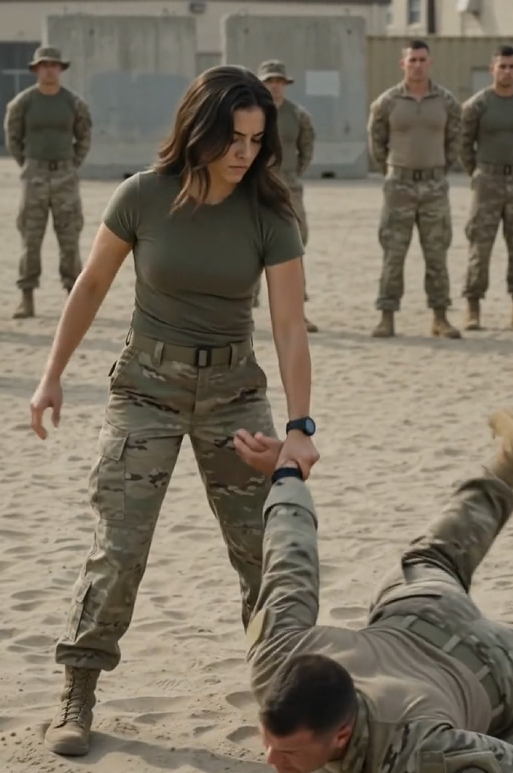
Quiet Female Combat Instructor. Those were the three words printed beside my name on the temporary training schedule taped to the entrance of Building Seven at Naval Amphibious Base Coronado. Before anyone had even met me, those words had already become the punchline of half the conversations taking place on the training yard. Some of the operators laughed openly as they walked past the schedule. Others simply smiled and shook their heads before continuing toward the obstacle course. I didn’t blame them. At twenty-two years old, standing barely five feet six inches tall with a lean athletic build and no combat patches decorating my sleeves, I looked nothing like the image most people expected when they imagined someone assigned to instruct one of the most demanding military units in America. My name was Emily Carter, and according to the paperwork everyone on the base had been allowed to read, I was a civilian performance specialist hired to evaluate close-quarter decision-making under stress. The description sounded ordinary enough. That was intentional. The documents didn’t mention where I had actually spent the previous four years, nor did they explain why my personnel file had been reviewed personally by officers who rarely concerned themselves with temporary instructors. Most people saw a young civilian. A handful of people knew there was more to the story. None of them were standing on the training yard that morning.
The California sun had barely climbed above the Pacific when I stepped through the gate carrying nothing except a small duffel bag and a weathered notebook whose corners had begun to fray from years of use. Salt air drifted across the base, mixing with the smell of sand, machine oil, and fresh coffee carried by sailors crossing the compound. In the distance, helicopters lifted from nearby pads while teams completed their morning conditioning runs without slowing their pace for the newcomer walking quietly toward the central training area. I had arrived thirty minutes early because my father had always believed punctuality revealed more about character than talent ever could. He had served in the Navy for twenty-seven years before retiring as a commander, and although he had never pressured me to follow his path, he had taught me one lesson that remained with me every day of my life. “The loudest person in the room is rarely the one paying the closest attention.” Looking around the bustling training yard, I realized that advice was about to become more valuable than ever.
Nearly twenty operators had already gathered around the large sand training pit reserved for combatives instruction. They represented different SEAL teams returning from separate deployments, each bringing years of operational experience that most civilians could scarcely imagine. Sun-faded uniforms, scarred hands, weathered faces, and quiet confidence told stories no résumé ever could. Some leaned casually against the wooden fence while others stretched or joked among themselves, but almost every conversation paused the moment they noticed me walking toward the center of the yard. Curiosity spread first. Then amusement. I heard one operator whisper that headquarters must have confused the instructor roster with a university internship program. Another quietly suggested someone had accidentally invited a graduate student instead of a combat specialist. A third wondered aloud whether I had gotten lost looking for the administrative offices. None of the remarks were shouted. They didn’t need to be. They were intended to be overheard, and they were.
Standing nearest the front of the group was Master Chief Lucas Grant, a man whose reputation seemed to arrive several seconds before he did. At six foot four with broad shoulders shaped by decades of demanding service, he possessed the effortless confidence that often followed those who had led difficult missions successfully. Stories about Grant circulated freely around the base. Younger sailors admired him. Senior officers respected him. Fellow operators trusted him without hesitation. He noticed me approaching, exchanged a quick glance with the men beside him, and allowed the faintest smile to appear. It wasn’t openly hostile. It was the smile of someone convinced he already understood exactly how the next hour would unfold.
An administrative officer stepped forward carrying a clipboard and cleared his throat. “Ladies and gentlemen, this morning’s instructor for the advanced decision-making assessment has arrived.” He turned toward me. “Ms. Carter, whenever you’re ready.”
=
I thanked him quietly before setting my duffel bag beside the edge of the training area. Rather than beginning with introductions, I spent a few moments simply observing the group in front of me. Years earlier, one of my own instructors had taught me that people often revealed more during silence than conversation. Some operators stood relaxed, genuinely curious. Others folded their arms, skeptical but patient. A few had already dismissed me entirely before I spoke a single word. None of those reactions surprised me.
Finally I looked up.
“Good morning.”
A few voices answered.
Most didn’t.
“My name is Emily Carter. For the next three weeks, I’ll be evaluating how teams process information when their expectations no longer match reality.”
One operator near the back laughed softly.
“I thought this was combatives.”
“So did I,” another replied.
Master Chief Grant spoke just loudly enough for everyone nearby to hear.
“With respect, ma’am… most of us have spent years making decisions under pressure.”
“I know,” I answered.
He tilted his head slightly.
“So what exactly are you planning to teach us?”
I smiled politely.
“Maybe nothing.”
That answer caught several people off guard.
Grant folded his arms.
“Then why are you here?”
“To see whether experience sometimes becomes a disadvantage.”
Several operators exchanged puzzled looks.
Grant’s smile returned.
“I’ve heard a lot of theories over the years.”
“I’m sure you have.”
“But this one’s new.”
“It usually is.”
The administrative officer quietly stepped backward, wisely choosing not to interrupt.
Grant took one slow step into the sand.
“So this isn’t really about fighting?”
“No.”
“It’s about thinking?”
“Mostly.”
He looked around at the rest of the team before returning his attention to me.
“And how do you plan to measure that?”
Instead of answering immediately, I walked toward a weathered wooden equipment box resting near the edge of the training area. Inside were several ordinary training objects—rubber markers, colored flags, notebooks, stopwatches, and protective gear. I reached inside, removed a simple tennis ball, and held it in my hand.
The operators looked confused.
Grant actually chuckled.
“A tennis ball?”
“Yes.”
“I was expecting something more impressive.”
“So was everyone else.”
He shrugged.
“I’ll play along.”
“I know.”
Without warning, I tossed the tennis ball gently toward him.
Grant caught it easily with one hand.
Several operators smiled.
He bounced it once against his palm.
“Now what?”
I looked directly at him.
“Tell me everything you noticed in the three seconds before you caught it.”
His smile faded.
“The ball.”
“What color were the cones behind me?”
He hesitated.
“I wasn’t looking.”
“How many people walked past the fence while the ball was in the air?”
Silence.
“What direction was the wind moving?”
Grant slowly lowered the ball.
“I don’t know.”
I nodded.
“Exactly.”
The amusement around the training yard became noticeably quieter.
I continued.
“You focused on what you expected mattered.”
Grant remained silent.
“You ignored everything else.”
One of the younger operators frowned.
“That’s normal.”
“It is.”
I smiled.
“Until the one thing you ignored becomes the thing that changes everything.”
For the first time that morning, nobody laughed.
High above the training yard, inside the observation room overlooking the sand pit, two senior officers watched the exchange through reinforced glass. One of them quietly closed a personnel folder that had remained classified for years before saying only four words.
“They’re reacting exactly as predicted.”
The other officer didn’t answer immediately.
His eyes never left the young instructor calmly standing alone in the sand.
Then he spoke just quietly enough that nobody else in the room could hear.
“They still have no idea… who approved her.”
PART 2
The silence hanging over the training yard lasted only a few seconds, but it was enough for everyone to realize the atmosphere had changed. The jokes hadn’t disappeared completely, yet they no longer sounded confident. Master Chief Lucas Grant stood in the center of the sand with the tennis ball resting loosely in his hand, replaying the last thirty seconds in his mind. It bothered him that such a simple question had exposed a blind spot he hadn’t even realized existed. Around him, several operators shifted their weight uneasily, pretending they hadn’t also failed to notice the details Emily Carter had pointed out. High above the yard, the two senior officers continued watching through the observation window without speaking. One of them, Rear Admiral Charles Whitmore, finally broke the silence. “Most instructors begin by proving how much they know,” he said quietly. “She begins by proving how much everyone else misses.” Beside him, Captain Andrew Collins nodded once. “That’s exactly why she was selected.” Neither officer mentioned the thick classified folder lying closed on the table between them. Even now, only a handful of people on the base had permission to open it.
Back on the sand, Emily accepted the tennis ball after Grant tossed it back. She slipped it into the equipment box and faced the formation again. “Most people think today’s lesson is about speed,” she said calmly. “It isn’t. It’s about assumptions.” One operator folded his arms. “With respect, ma’am, assumptions aren’t what get us through missions.” Emily looked at him with a small smile. “No?” He shook his head confidently. “Training does.” She nodded. “Training is built on recognizing patterns.” The operator agreed. “Exactly.” Emily continued, “And when the pattern suddenly changes?” Nobody answered. She let the silence linger before speaking again. “The human brain tries to force new information into old expectations. Sometimes that’s efficient. Sometimes it becomes dangerous.” Master Chief Grant watched her carefully now. He wasn’t smiling anymore. He had expected motivational speeches or physical demonstrations. Instead, she seemed determined to dismantle the way they thought before asking them to do anything else.
Emily reached into her duffel bag and removed a stack of laminated photographs. Without explaining what they were, she handed one to each operator. Every image showed a crowded street, a dockyard, a warehouse, or an ordinary parking lot filled with dozens of small details. “You have fifteen seconds,” she instructed. “Look carefully.” The operators studied their photographs while the countdown quietly ticked away on her stopwatch. At exactly fifteen seconds, she collected every picture. “Now,” she said, “write down everything you remember.” Pens moved quickly across notepads. Some operators filled half a page. Others barely wrote a few lines. When everyone finished, Emily began asking simple questions. “How many red vehicles appeared in your image?” Several operators answered confidently. She nodded. “Correct.” Then she asked, “How many children were visible?” Most hesitated. “How many exit signs?” Silence. “How many people looked directly toward the camera?” More silence. The confidence that had filled the yard earlier that morning continued fading with each unanswered question.
Grant finally spoke. “You’re measuring selective attention.” Emily looked pleasantly surprised. “Exactly.” He nodded slowly. “We focus on what we believe matters.” “Yes,” she replied. “And sometimes that’s precisely why we overlook what actually matters.” One younger operator raised his hand almost instinctively before catching himself and lowering it again. “Ma’am…” Emily smiled. “Go ahead.” He cleared his throat awkwardly. “Is this really how you evaluate decision-making?” She answered honestly. “No.” The operator frowned. “Then what are you evaluating?” Emily looked across the entire formation before replying. “Whether you’re willing to admit you can still learn.” That answer settled heavily over the group. No one argued with it.
Captain Collins entered the training yard carrying another clipboard. “Ms. Carter,” he called, “you have fifteen minutes before the next scheduled exercise.” She thanked him before turning back to the operators. “Perfect.” She glanced toward the obstacle course running alongside the beach. “Let’s take a walk.” Confused but curious, the team followed her across the base. Instead of stopping at the obstacle course, Emily led them to a quiet overlook facing the Pacific Ocean. Waves crashed rhythmically against the shoreline below while helicopters passed far offshore. The location seemed completely unrelated to combat training. Grant looked around. “What’s the lesson here?” Emily didn’t answer immediately. Instead, she pointed toward the horizon where several small boats moved slowly across the water. “How many boats do you see?” The operators counted. Answers ranged from six to nine. Emily nodded. “Now stop looking at the boats.” Several frowned. “Look between them.” The team stared again. After a few seconds, one operator quietly said, “There’s a Coast Guard cutter farther out.” Another pointed toward a sailboat hidden behind the glare of the sun. A third noticed a rescue helicopter approaching from the south that none of them had mentioned before. Emily smiled. “Sometimes the obvious object isn’t the most important thing in your field of view. Sometimes everything around it tells the real story.”
Grant found himself studying Emily instead of the ocean. There was something unusual about the way she taught. She never claimed to be smarter than anyone else. She never spoke about her own accomplishments. Every lesson quietly redirected attention back toward the students themselves. It reminded him less of a traditional instructor and more of someone who had spent years solving problems nobody else noticed. As they walked back toward the training yard, Grant finally asked the question that had been bothering him since morning. “Where did you learn to teach like this?” Emily’s smile softened, though her eyes briefly drifted toward the weathered notebook still tucked beneath her arm. “Someone once taught me that surviving difficult situations rarely depends on being the strongest person present.” Grant waited. She continued, “It depends on noticing what stronger people ignore.” He studied her face for a moment. “Who taught you that?” Emily hesitated just long enough for him to realize the answer mattered. “Someone who isn’t here anymore.”
Before Grant could ask another question, a black SUV rolled quietly through the far security gate and stopped outside the administration building. This time, however, everyone noticed. Four Marines exited first, followed by an elderly man in a dark blue suit carrying no visible rank or insignia. Captain Collins stopped walking almost immediately. His expression changed from curiosity to surprise. “That…” he murmured, “…wasn’t on today’s schedule.” Rear Admiral Whitmore, watching from the observation room above, recognized the visitor instantly. Without saying a word, he picked up the classified personnel folder lying on the table and locked it inside a secure metal case.
Down on the training field, Emily noticed the arriving vehicle but gave no visible reaction.
The elderly man did.
The moment his eyes found Emily standing among the SEAL operators, he stopped walking entirely.
For several long seconds, he simply stared.
Then, almost under his breath, he whispered a single name that nobody on the training yard had ever heard before.
Not “Emily.”
Not “Ms. Carter.”
A completely different name.
And judging by the expression on his face…
…it belonged to someone he had believed was gone a very long time.
PART 3
The entire training yard seemed to slow down the moment the older man stepped closer. The SEAL operators who had spent years learning to remain calm under pressure instinctively noticed the change in the atmosphere. Nobody had given an order. Nobody had raised their voice. Yet every person present understood that something important had just entered the room. Master Chief Lucas Grant watched the visitor carefully, then glanced toward Emily Carter. For the first time since she arrived at Coronado, she looked genuinely surprised. It lasted only a fraction of a second, but Grant saw it. The woman who had calmly challenged an entire formation, who had dissected their thinking without hesitation, had finally encountered something she had not expected.
The older man stopped several feet away and studied her silently. His gray hair, formal posture, and careful movements suggested someone who had spent a lifetime in positions where every decision carried consequences. Behind him, the Marines accompanying him remained perfectly still. They weren’t there to intimidate anyone. They were there because whoever this man was, he was someone the military still listened to.
Captain Andrew Collins walked forward first.
“Sir, I wasn’t informed we were receiving visitors.”
The man looked at him briefly.
“You weren’t supposed to be.”
The answer was calm, but it carried enough authority that Collins immediately stepped aside.
The visitor turned back toward Emily.
“You’re older than the last photograph I saw.”
Emily’s expression remained controlled.
“And you’re still terrible at announcing yourself.”
A few SEALs exchanged surprised looks.
Nobody expected that tone.
Not from her.
Not toward him.
The older man almost smiled.
“Some things never change.”
Grant looked between them.
“Does someone want to explain what’s happening?”
Emily glanced at the operators around her before answering.
“Apparently, my past finally caught up with me.”
The sentence immediately changed the mood.
The team that had spent the morning wondering who she was now realized they had been asking the wrong question.
They weren’t wondering what a young instructor could teach them.
They were wondering what she had already lived through.
The visitor extended his hand.
“Dr. Samuel Reed.”
Grant recognized the name immediately.
Not because of the rank.
Because of the reputation.
Reed had spent decades working with military training programs, psychological preparation, and performance evaluation. He wasn’t a field commander. He wasn’t a combat celebrity. But many senior officers considered his research some of the most influential work behind modern military preparation.
Emily shook his hand.
“Still studying people?”
“Still avoiding attention?”
She gave a small smile.
“Yes.”
The exchange confused everyone.
Grant finally asked,
“How do you know each other?”
Dr. Reed looked at Emily before answering.
“Because before she became your instructor, before she became the person standing in front of you today, Emily Carter was one of the most promising candidates in a specialized leadership development program.”
The SEALs listened carefully.
“She wasn’t selected because she was the strongest,” Reed continued.
“She wasn’t selected because she was the fastest.”
He looked toward the team.
“She was selected because she noticed things other people missed.”
Emily looked away slightly.
“I was a student.”
Reed shook his head.
“No.”
He smiled faintly.
“You were the student who kept correcting the instructors.”
A few operators looked surprised.
Grant almost laughed.
“That sounds like her.”
Emily gave him a look.
“Don’t encourage him.”
For the first time all day, the tension relaxed.
But Dr. Reed wasn’t finished.
“I came here because the command staff requested an explanation.”
“Of what?”
“Of why someone with your background chose to disappear.”
The yard became quiet again.
Emily looked toward the ocean.
The waves continued crashing against the shore, completely unaware of the conversation happening behind them.
“I didn’t disappear.”
Reed nodded.
“You stepped away.”
“Yes.”
“Why?”
The question seemed simple.
But everyone understood the answer mattered.
Emily took a slow breath.
“Because I spent years proving I could handle pressure.”
She looked back at the team.
“Then I realized I had never learned how to live without it.”
Nobody interrupted.
“My father spent his entire career serving. I respected him for that. I still do.”
Her fingers briefly touched the small notebook she carried.
“But I also saw what happens when people become nothing except their job.”
Grant listened carefully.
Emily continued.
“At some point, I wanted to know who I was when nobody needed me to solve a problem.”
The honesty of the answer surprised everyone.
The SEALs had expected a dramatic explanation.
A secret mission.
A hidden achievement.
Instead, they heard something much more ordinary.
A person who wanted a different life.
Dr. Reed nodded slowly.
“And that’s exactly why I recommended you for this position.”
Emily looked at him.
“You recommended me?”
“Yes.”
“Why?”
“Because the best instructors aren’t always the people who remember the most.”
He looked at the team.
“They’re the people who understand what it feels like not to know.”
The lesson landed differently this time.
The SEAL operators who had laughed at her that morning no longer saw a young woman trying to prove herself.
They saw someone who had walked into the yard without needing recognition.
Someone who had spent the entire day teaching them without once talking about herself.
Master Chief Grant stepped forward.
“Ma’am.”
Emily looked at him.
“I owe you an apology.”
She shook her head slightly.
“For what?”
“For deciding who you were before I knew anything about you.”
She considered his words.
Then nodded.
“That’s actually the first lesson.”
Grant smiled.
“Figures.”
A few operators laughed quietly.
The same people who had mocked her hours earlier now stood listening.
Not because she demanded respect.
Because she earned it.
Over the next three weeks, Emily Carter continued training the team. She never became louder. She never tried to dominate the room. She never reminded anyone of what she had done before arriving at Coronado. Instead, she focused on what she had come there to teach: awareness, patience, communication, and the importance of recognizing what existed beyond the obvious.
Months later, when new operators arrived at the base and heard stories about the young instructor who had walked into a yard full of experienced SEALs and changed the way they thought, they expected to hear about some impossible achievement.
They expected a story about strength.
About competition.
About proving someone wrong.
But the veterans always corrected them.
Because the most important thing Emily Carter taught them wasn’t how to win a challenge.
It was how to stop assuming they already knew everything.
And every time someone asked why the entire SEAL team had gone silent that morning at Coronado, the answer was always the same.
They weren’t silent because they had discovered someone stronger than them.
They were silent because, for the first time in a long time…
Someone had shown them how much they still had left to learn.