CHAPTER 1
To understand the architecture of grief, you must first understand the brutal, physical weight of an empty chair. It sits in your peripheral vision, a constant, mocking reminder of the phantom who used to occupy it. For three years, I had navigated the agonizing silence my father left behind. He was a man built of calloused hands and quiet, profound generosity, and when his heart suddenly failed, he took the warmth of our small world with him.
I was twenty-six years old, suffocating under a mountain of his remaining medical debt, practically living behind the counter of The Rusty Spoon, the neighborhood diner I managed on the edge of the city. I was exhausted to the marrow of my bones. Empathy felt like a luxury I simply could no longer afford.
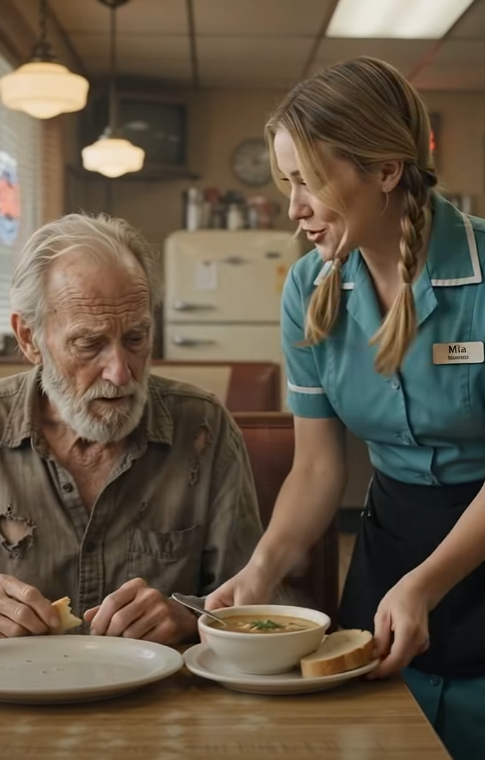
It was a bleak, freezing Tuesday evening in late November. The sky had bruised into a heavy, violent violet, and the diner was caught in the agonizingly slow lull between the dinner rush and closing time. The air smelled of stale coffee, industrial floor cleaner, and burnt hash browns.
I was aggressively wiping down the laminate counter, my hands red and raw, desperately trying to scrub away my mounting panic over the impending rent payment.
Then, the heavy glass door chimed.
I didn’t look up immediately. I just let out a heavy, exhausted sigh. “Take any booth you like, folks. I’ll be right with you.”
“We’re actually looking for someone specific.”
The voice was elegant, polished, and entirely out of place in my greasy diner.
I snapped my head up. Standing in the entryway was a woman draped in an immaculate, structured camel-hair coat that cost more than my car. Her dark hair was swept into a flawless chignon. Beside her stood a young girl, perhaps eight years old, clutching a small, half-eaten baguette like a lifeline. They looked like they had stepped out of a luxury magazine and directly onto my cracked linoleum floor.
I threw my damp rag into the sink, wiping my hands on my apron. “Can I help you?”
The elegant woman stepped forward. She wasn’t carrying a designer handbag. She was carrying a thick, slightly wrinkled, manila envelope.
She stopped directly in front of the register. Her pale blue eyes scanned my face with a terrifying, piercing intensity, reading my name tag.
“Mia,” the woman whispered, her voice cracking slightly. She slid the manila envelope across the scratched counter. “This is for you.”
I stared at the thick paper, a cold dread instantly coiling in my gut. In my world, an unexpected envelope delivered by a wealthy stranger usually meant a lawsuit, a final eviction notice, or a collections agency escalating their tactics.
“I can’t accept this,” I stammered, physically taking a step backward, terrified to touch the paper. “If this is from the hospital billing department, you need to speak with my lawyer. I’m already making the minimum monthly payments.”
The elegant woman’s severe expression instantly softened. A sad, gentle smile touched her lips.
“Then accept something else,” she replied softly.
She didn’t push the envelope closer. Instead, she reached into the deep pocket of her coat. She carefully extracted a single, folded index card and placed it delicately on the counter next to the envelope.
The paper was incredibly old. The edges were deeply yellowed, the corners worn thin and soft from decades of handling. It looked like a fragile, historical artifact.
Across the top of the card, written in the looping, faded blue ink of a generation that actually practiced cursive, were three simple words.
Dad’s Favorite Soup.
I frowned, entirely bewildered. I looked from the card to the woman. “I don’t understand. What is this? Why are you giving me a recipe?”
The woman’s icy blue eyes instantly filled with thick, heavy tears. They spilled over her lashes, ruining her perfect makeup.
“Because he asked me to,” the woman choked out, her voice trembling with raw, unadulterated grief. “Before he passed away last week… he made me promise. He said if I ever found the young waitress who treated him like family when the rest of the world had discarded him… she should have this.”
The air in the diner vanished.
With shaking, hesitant fingers, I reached out and slowly unfolded the fragile recipe card.
The front contained the meticulous instructions for a hearty, peasant-style beef stew. But it was the back of the card that made the breath catch violently in my throat.
There, written in a significantly shakier, weaker handwriting—the handwriting of a man nearing the end of his journey—was a deeply personal message.
“You didn’t just feed my empty stomach. You fed my hope.”
A single, hot tear escaped my lashes, rolling slowly down my cheek to splash onto the laminate counter.
Then another.
CHAPTER 2
The sterile, fluorescent lights of the diner seemed to dim, transporting me violently back to a freezing, brutal night nearly six years ago.
I was twenty, brand new to managing the floor, overwhelmed and terrified of my tyrannical boss. The dinner rush had been catastrophic. It was a torrential blizzard, and the diner was packed with angry, stranded commuters.
In the chaos, an old man had slipped through the front door.
He was practically a ghost. His clothes were threadbare, completely saturated with freezing rain. He didn’t ask for a table. He simply huddled in the small vestibule near the bathrooms, desperately trying to absorb the ambient heat of the restaurant, terrified of being thrown back into the storm.
My manager had spotted him. He had marched over, his face flushed with corporate fury, and began aggressively screaming at the old man to vacate the premises, calling him a loiterer and a liability. The old man hadn’t fought back. He had simply lowered his head, shivering violently, and turned toward the freezing street.
I hadn’t thought. I hadn’t calculated the risk to my own job.
I had sprinted across the dining room, intercepted the old man before he reached the door, and physically placed myself between him and my furious manager.
“He’s my uncle,” I had lied flawlessly, my heart hammering against my ribs. “He’s waiting for me to finish my shift. I’m paying for his meal.”
I had guided the terrified, freezing man to the quiet, secluded corner booth near the kitchen. I didn’t give him a menu. I went straight to the line, grabbed the largest, most massive bowl of our house beef stew, and loaded it with extra meat and fresh bread.
I served it to him myself. I didn’t ask for his story. I didn’t pry into his trauma. I just made sure his coffee cup was never empty.
When my shift ended, I paid his bill from my own meager tips. Before he left, he had looked at me with eyes so full of profound, staggering gratitude that it had haunted me for weeks. I never learned his name. I never saw him again.
Until today.
I wiped my wet face with the back of my sleeve, looking up at the elegant woman standing in front of my register.
“That was him,” I whispered, my voice breaking. “The man in the blizzard.”
The woman nodded, wiping her own tears with a silk handkerchief.
“His name was Arthur,” she explained softly. “He was my father. He suffered from severe, early-onset dementia. During a terrible episode, he wandered away from his care facility. He was lost in the city for three agonizing days during that storm. The police couldn’t find him. The private investigators couldn’t find him.”
She reached out and gently squeezed my trembling hand.
“If you hadn’t pulled him into that booth,” she cried, “if you hadn’t given him that hot soup and a safe place to sit… the doctors said he wouldn’t have survived the night. You kept him alive long enough for us to finally track his location the next morning.”
I sobbed, the crushing weight of the memory overwhelming my defenses. I had thought I was just performing a small act of rebellion against my manager. I had no idea I was saving an entire family from a lifetime of grief.
“He talked about you constantly,” Arthur’s daughter continued, her smile returning. “He couldn’t remember his own address, but he never, ever forgot the kind girl with the dark hair who lied to protect him. He wrote that message on the back of his mother’s prized recipe card months ago.”
She pushed the thick manila envelope closer to me.
“He also made one more request,” she said, her tone shifting into something fiercely serious.
I looked up, wiping my eyes. “What was it?”
The elegant woman glanced around the empty, slightly worn diner. Then, she raised a manicured finger and pointed directly toward the dark, secluded corner booth where her father had sat six years ago.
“He wanted one seat in this diner,” she stated, her voice echoing with absolute authority, “…to always, permanently be reserved for anyone who’s freezing, hungry, and cannot afford a meal.”
The diner fell into a heavy, profound silence.
I looked toward the empty vinyl booth. I thought about my own father, about his generosity, and the crushing poverty that had swallowed me since his death.
“I would love to honor that,” I whispered truthfully. “But I’m barely keeping the lights on. I can’t afford to give away meals every day. I’m fighting foreclosure.”
The woman smiled—a brilliant, predatory smile that belonged in a high-rise boardroom.
“Open the envelope, Mia,” she commanded softly.
CHAPTER 3
My hands shook violently as I broke the seal on the heavy manila envelope.
I pulled out a thick stack of legal documents. I expected to see a small check, perhaps a generous tip for the meal I had bought years ago.
Instead, I stared at a certified bank ledger.
“My father didn’t just wander the streets,” the woman explained, leaning against the counter. “Before his illness, he was the founder and majority shareholder of Vanguard Acquisitions.”
The color completely drained from my face. Vanguard was the exact predatory firm that held the massive medical debt from my father’s cancer treatments. They were the ones threatening to seize the diner by the end of the month.
“I am the CEO now,” she continued smoothly. “And yesterday morning, I executed my executive bypass authority. I personally purchased the entire delinquent debt portfolio of this specific address from my own firm.”
“You… you bought the debt?” I stammered, the paper rattling in my trembling hands.
“Let me be crystal clear,” she countered, stepping aggressively into my personal space, her eyes blazing with absolute conviction. “The debt on this building is officially satisfied in full. Vanguard has zero jurisdiction here. You own the building, the land, and every single booth in this room. Free and clear.”
Fresh, overwhelming tears instantly filled my eyes, spilling over my lashes in a continuous flood. I gripped the edge of the counter to keep my knees from buckling.
“And the medical debt?” I wept, terrified to ask.
“Liquidated,” she smiled. “Erased. You owe absolutely nothing to anyone, Mia. You are entirely free.”
I broke down crying. It wasn’t a quiet weeping; it was the visceral, exhausting release of years of agonizing struggle, terrifying phone calls, and backbreaking labor. The crushing weight of poverty was crashing down, instantly evaporating into the warm air.
“Why… why would you do this?” I choked out, looking at her as if she were an apparition.
She reached across the counter and wiped a tear from my cheek.
“Because a single act of kindness shouldn’t be penalized by a balance sheet,” she said softly. “You spent your evening protecting a stranger’s dignity when the rest of the city had discarded him. Now, it’s time someone protected yours.”
She tapped the legal documents.
“There is a ten-thousand-dollar trust attached to that deed,” she added. “It is specifically earmarked to cover the cost of the food for my father’s booth. Every single day. Forever.”
I walked rapidly around the edge of the counter, threw my arms open, and pulled the billionaire CEO into a fierce, crushing embrace. We held each other tightly, two women bound by the memory of an old man and a bowl of beef stew.
The very next morning, before the sun even crested the Chicago skyline, I arrived at the diner.
I didn’t turn on the open sign right away. I went to the back office, found a piece of reclaimed wood, and carefully painted a message in bright, bold white lettering.
I walked over to the secluded corner booth. I bolted the wooden sign directly into the wall, right above the center of the table.
It read:
“If you’re hungry, this seat is already paid for. Please, sit down.”
The transformation of The Rusty Spoon over the next few months was nothing short of miraculous.
I used the recipe on the back of the index card. Every morning, I brewed a massive, industrial pot of Arthur’s favorite beef stew. The rich, heavy scent permeated the block, drawing people in from the cold.
When the first homeless man tentatively walked through the door, terrified and shivering, I didn’t yell. I didn’t call the police. I walked him directly to the corner booth, sat him down beneath the wooden sign, and served him the largest, hottest bowl of stew I could carry.
Customers stopped their conversations to read the sign. They watched the interactions.
The story of Arthur’s booth spread through the working-class neighborhood like wildfire. And almost immediately, the atmosphere inside the diner fundamentally shifted.
It started small. A local mechanic paid for his coffee and left an extra ten-dollar bill on the counter, pointing to the corner booth. “For the next guy,” he mumbled awkwardly.
Then a teacher left twenty. Then a nurse left fifty.
A movement was born. Customers who could afford it began leaving extra cash, purchasing “suspended meals”—warm dinners and cups of coffee paid forward for the ghosts of the city, for someone they would probably never, ever meet. The diner was packed wall-to-wall, buzzing with a desperate, beautiful solidarity.
But the true test of a sanctuary is not how it operates in the light, but how it responds when the darkness inevitably returns.
CHAPTER 4
It was late January, exactly one year later. The sky had bruised into that familiar, heavy violet, and the temperature had plummeted violently. I was walking out of the kitchen, carrying a fresh tray of coffee mugs, when the heavy front door violently swung open.
A rush of freezing air swept into the dining room.
Standing near the entrance, hesitating on the welcome mat, a small boy appeared.
He couldn’t have been older than eight. He was wearing a shockingly thin, uninsulated jacket. His hands were bright, violently red from the freezing cold. Thick snow covered his worn-out shoes, dripping dirty puddles onto the pristine hardwood floor.
And standing directly beside him, attempting to hide behind his thin leg…
Was a little girl, even younger than him, gripping his freezing hand with a desperate, terrifying tightness.
The restaurant grew noticeably quieter. The clinking of silverware slowed. People in the front booths looked away awkwardly, suddenly intensely interested in their napkins.
The little boy slowly, nervously approached the main counter. He looked terrified of the bright lights and the warm patrons.
“Excuse me…” he rasped, his voice trembling.
I set my tray down instantly. The absolute moment my eyes landed on the boy’s face, my cheerful customer-service smile completely disappeared.
It wasn’t because I was angry about the dirty snow tracking onto my floors.
It was because I recognized that exact, specific look instantaneously.
It was the same, hollow hunger. The same paralyzing fear. The same suffocating, soul-crushing embarrassment that Arthur had carried into this exact room.
The little boy carefully, agonizingly uncurled his red, freezing fist.
A pathetic collection of dull, copper coins rested in his palm.
“Can we please buy one bowl of soup…” the boy whispered, looking down at his worn shoes, “…and share it?”
Absolute silence flooded the front half of the restaurant.
I stood frozen behind the marble counter, staring down at the meager pile of pennies and dimes in the boy’s trembling hand for several agonizing seconds.
Then, my eyes slowly filled with thick, heavy tears.
I walked around the counter, crouching down until I was perfectly level with the freezing children. I looked at them with a gentleness that could break stones.
“What are your names, sweethearts?” I asked softly.
“Leo,” the boy whispered, his teeth chattering. He pulled the smaller child slightly forward. “And this is my sister, Emma.”
Emma gripped her brother’s thin jacket tighter, burying her dirty face into his side.
With infinite tenderness, I reached out. I didn’t take the money. I gently wrapped my warm, soft hands around Leo’s freezing fist, slowly closing his small fingers back over the coins.
“Put those away in your pocket, sweetheart,” I instructed, my voice thick with emotion.
Leo immediately shook his head, a flash of pure panic crossing his face, assuming he was being rejected and thrown back into the blizzard.
“But… but this is all the money we have in the whole world,” the boy pleaded, tears welling in his eyes.
I smiled—a soft, radiant expression that cut through the boy’s terror.
“You don’t need money here, Leo,” I declared.
I stood up and gently placed my hand on his thin shoulder, guiding him and his sister past the crowded tables, walking them directly toward the back of the diner.
I walked them to the corner booth.
I sat them down on the warm vinyl, directly beneath the wooden sign.
“Are you sure?” Leo asked, staring at the empty table as if it were a trap.
I looked up at the ceiling, thinking of an old man in a freezing storm, and the billionaire daughter who had saved my life.
“I’m absolutely sure,” I whispered.
I went to the kitchen and poured two massive, steaming bowls of Arthur’s favorite beef stew. I loaded the tray with fresh bread, hot chocolate, and extra butter.
When I returned to the booth and set the feast down in front of the starving children, Leo stared at the food like it was an optical illusion.
“Who paid for this?” Leo asked, his voice full of wonder.
I smiled, wiping a tear from my cheek.
“A very good friend of mine,” I replied. “He wanted to make sure you were safe.”
And every day after that—someone in desperate need sat at that corner booth. A runaway teenager. A struggling veteran. A mother escaping a nightmare.
They ate the hot soup. They felt the overwhelming, unconditional warmth of the sanctuary. They sat in the very seat that had once belonged to a terrified, freezing old man.
They never knew Arthur’s name. They never saw his photograph.
But as the brutal Chicago winters raged outside the glass windows, they always, undeniably, felt the profound and explosive kindness he had left behind.
If you want more stories like this, or if you’d like to share your thoughts about what you would have done in my situation, I’d love to hear from you. Your perspective helps these stories reach more people, so don’t be shy about commenting or sharing.