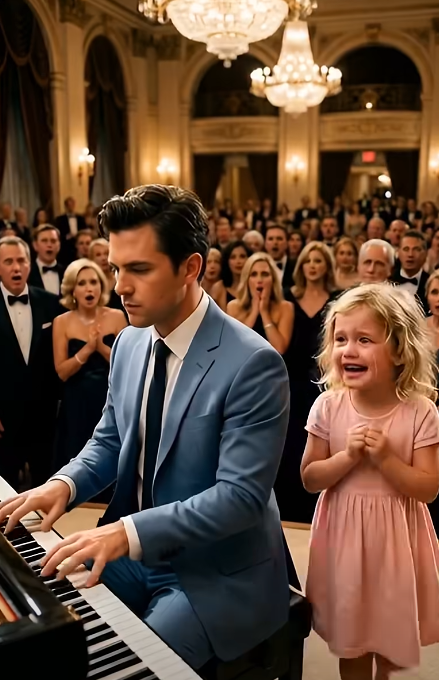
The ballroom at the Sterling Grand Hotel in Boston looked like a photograph torn from a magazine that ordinary people weren’t allowed to read. Crystal chandeliers fractured the light into a thousand icy prisms, pouring a soft, golden glow across the polished marble floors. Waiters in pristine white gloves moved with the synchronized, flawless precision of clockwork soldiers. Beneath the faint, tasteful string quartet playing in the corner, a quiet hum of conversation drifted through the air—a second, unspoken performance made entirely of wealth, political influence, and carefully practiced smiles.
It was my twenty-first birthday. I am Julian Sterling, the only son of one of the city’s most formidable, old-money families.
My mother, Victoria Sterling, carried herself like a queen accustomed to absolute devotion. She glided through the room in a gown of emerald silk, welcoming tech investors, university donors, city judges, and longtime family friends as if the evening were not merely a birthday celebration, but a territorial flag planted in the center of the world she commanded. And every few minutes, she returned to her favorite talking point with unmistakable pride: my talent at the piano.
I sat at a glossy black Steinway concert grand positioned exactly in the center of the room. I was dressed in a tailored, suffocating midnight-blue suit. My hands moved across the ivory keys with flawless precision. I played Chopin. Every note landed exactly where it should. Every dynamic phrase was controlled. Every transition was technically immaculate.
And yet… the room only admired me. They didn’t feel me. I didn’t even feel myself.
The guests nodded politely. Some smiled over their champagne flutes. A few whispered about my “prodigious discipline.” But the music passed over them like a cool breeze instead of moving through their souls. I was a well-oiled machine, performing a trick I had been taught since I was four.
Downstairs, in the subterranean catering kitchen where the air was thick with the scent of melted butter, roasted garlic, and panic, Sarah Evans nervously twisted the strings of her stained apron. I would learn her name later, along with the fact that she had taken a double catering shift because her rent was past due and her babysitter had vanished at the last minute. She had no choice but to bring her daughter into the belly of the beast.
Her little girl, Maya, was seven years old. She was small for her age, with wild brown curls and the quiet, observant demeanor of a child whom life had already taught not to take up too much space.
Sarah had hidden Maya on a stool in a quiet storage corner with a half-eaten sandwich and strict instructions. “Just for a little while, sweetheart,” Sarah had whispered. “Mommy just needs to finish passing out these appetizers, and then we’ll go home.”
But as the faint sound of my piano drifted down the service elevator shaft, Maya lifted her head.
Maya had never taken a lesson. Sarah could barely afford groceries, let alone a piano. But Maya possessed a dangerous curiosity. She slipped off her stool—barefoot, because her worn canvas shoes had rubbed painful blisters into her heels—and followed the melody. She navigated the labyrinth of linen carts and scowling chefs until she found herself standing at the edge of the grand ballroom.
The space was enormous. Blindingly bright. Almost alien.
At its center, I was finishing my piece.
Maya froze near the velvet curtains. Her faded, oversized cotton dress made her look like a tiny ghost against the grandeur. A few wealthy guests noticed her and chuckled, assuming the help’s child had wandered in by mistake. My mother, noticing the distraction, narrowed her eyes in pure disgust. Sarah, arriving seconds later with terror written across her face, nearly dropped her silver tray.
“Maya,” Sarah hissed softly, trying to grab the girl’s arm. “Baby, come here right now.”
But I had stopped playing. The room fell into an uncomfortable, heavy silence.
Maya ignored her mother. She walked right past the billionaires and politicians, her bare feet padding softly against the marble, until she stood right beside my bench. She looked at the keys, then up at me. Her eyes were steady. Not bold. Not defiant. Just heartbreakingly honest.
“Can I try?” she asked.
A ripple of condescending laughter spread through the crowd. My mother’s smile tightened into a weapon.
“I am so sorry, Mr. Sterling,” Sarah rushed forward, her face burning with humiliation. “She didn’t mean to interrupt. I’ll get her out of your sight.”
I raised my hand, stopping Sarah in her tracks. For a moment, I simply studied the child.
“You want to play?” I asked, my voice echoing slightly in the quiet room.
Maya nodded. “Just a little.”
Someone in the back snickered, but I stood up from the bench and stepped aside. “Then play.”
“Julian, do not indulge this,” my mother hissed, stepping forward.
I ignored her. I gave Maya a small, reassuring nod.
Carefully, as though afraid the piano might bite her, Maya climbed onto the leather bench. She placed her tiny fingers on the keys.
The first notes were hesitant. The next phrase wasn’t.
What flowed from the piano didn’t sound like a performance. It sounded like a raw, bleeding memory. It sounded like hunger. It sounded like rain tapping against the window of a cramped, freezing apartment. It sounded like a child teaching herself how to survive disappointment by turning it into something beautiful.
The melody lacked technical perfection—her fingering was completely wrong—but it overflowed with an agonizing amount of feeling. It moved through the ballroom like a tidal wave, violently stripping away the polished, fake distance of the elite. Conversations died. Champagne glasses were slowly lowered. The condescending smiles vanished.
No one was laughing anymore.
I stood beside the piano, absolutely paralyzed. I had spent fifteen years mastering scales, interpretation, and etiquette. I knew how to play perfectly. But this barefoot little girl was doing something I had forgotten how to do.
She was telling the absolute truth.
When her tiny hands pressed the final chord, the silence in the room was deafening. My eyes were wet. I walked slowly to the piano, picked up a folded sheet of unfinished, handwritten music I had been struggling with for six months, and held it out to her.
“I’ve been stuck on this forever,” I whispered, my voice thick. “Would you finish it the way you hear it?”
Sarah looked like she was going to faint. “Sir, please… she doesn’t know anything about formal music.”
Maya glanced at my complex sheet music and looked up at me with wide eyes. “I can’t read the notes, mister.”
I let out a quiet, disbelieving laugh, dropping to one knee so we were at eye level. “Maya, that might be the absolute least important thing about you.”
Suddenly, the blinding flash of a smartphone camera broke the spell. Someone had recorded the entire thing. I didn’t know it then, but as Maya’s mother dragged her away into the kitchen, the video was already uploading. By the time I woke up the next morning, my mother was screaming into her phone. The video had twenty million views, and the Sterling family empire was about to declare war on a seven-year-old girl.
“Get the legal team on the phone immediately!” my mother yelled, pacing the length of our penthouse living room like a caged leopard. “I want injunctions! I want cease-and-desists! Claim our privacy was violated! Sue the catering company!”
I sat on the velvet sofa, nursing a cup of black coffee, watching her spiral. The internet was captivated by the stark, undeniable contrast of the video: the grand hotel, the wealthy heir, the barefoot little girl in the faded dress, and the utter silence of a room of billionaires brought to tears by a child.
Messages were flooding my social media. People called her gifted. A prodigy. An angel.
My mother, Victoria, called her a parasite.
“You don’t understand, Julian,” my Uncle Richard said smoothly, walking into the room. Richard Sterling was a man whose reputation was built on massive philanthropy and political legacy. He preferred solutions that left no trace. “The media isn’t focusing on your birthday. They are painting us as the greedy elite who employ starving children. It’s a PR nightmare. I will handle the caterer. Quietly.”
“Do not touch them,” I warned, my voice hardening.
Richard chuckled, patting my shoulder. “Focus on your conservatory auditions, Julian. Let the adults manage the family image.”
What they didn’t know was how deeply I resented the cage they had built around me. I didn’t distance myself from Sarah and Maya. Instead, I bypassed my family’s security, found the catering company’s employment logs, and tracked them down.
I drove my car to a neighborhood in Dorchester that my mother wouldn’t even look at on a map. I walked up three flights of stairs in a decaying brick building and knocked on a peeling wooden door. I arrived without cameras, without a driver, and without my tailored suits. I wore jeans and a hoodie. In my hands, I carried a paper bag of fresh bakery pastries and a heavy stack of blank music notebooks.
Sarah opened the door, the security chain still engaged. Her eyes widened.
“You really came,” she breathed.
“I told you I would.”
Maya peeked out from behind her mother’s legs. “Did you bring the music, mister?”
For the first time in my life, a genuine smile broke across my face. “I brought paper, Maya. I thought maybe you could write your own.”
Over the next week, I kept coming back. I found an old, out-of-tune upright piano in the basement of a nearby community church. I paid the custodian to let us use it. I would sit on a folding chair and simply watch Maya play. She shaped fragments of emotion into breathtaking melodies while I sat there, feeling as if I were seeing color for the very first time.
She wasn’t just teaching me about music; she was reminding me of my own pulse.
“When you play,” I told her one rainy afternoon in the basement, “it feels like the room is finally telling the truth.”
Maya shrugged, swinging her little legs under the bench. “It just makes things feel less lonely, Julian.”
I looked over at Sarah. She had turned her back to us, pretending to organize her catering apron, but I could see her shoulders shaking. She was crying.
But my Uncle Richard had not remained passive.
Three days later, I arrived at the apartment to find Sarah sitting at her tiny kitchen table, her face buried in her hands. A thick, cream-colored envelope bearing the Sterling family legal crest sat in front of her.
“I can’t fight people like your family, Julian,” Sarah whispered, her voice broken. “They threatened to have child services investigate my living conditions. They threatened to have me fired from every catering company in Boston. We have to stop this.”
Anger, hot and blinding, rose in my chest. “They do not get to decide who deserves to make music.”
“Maybe not,” Sarah cried. “But people like us always pay the price while people like you make the rules! Please, just leave us alone.”
I left the apartment that night with my fists clenched so hard my knuckles were white. I made a few phone calls to professors I respected at the New England Conservatory—people who cared more about raw art than Sterling money.
The next morning, I returned to Sarah’s door with an official scholarship offer to the Conservatory’s preparatory program for exceptionally gifted children. Full tuition. Private lessons. A grand piano for their apartment. Everything covered by a private donor—me.
Sarah wept as she read the letter. For the first time, she allowed herself to believe a door was actually opening.
But when I returned home that evening, my Uncle Richard was sitting in my dark bedroom, swirling a glass of whiskey. He tossed a familiar piece of paper onto my bed. It was the scholarship offer. It had a massive, red “DENIED” stamp across it.
“You really thought you could bypass me in this city, Julian?” Richard smiled, a terrifying, dead look in his eyes. “The girl doesn’t go to the Conservatory. In fact, if you push this, the girl and her mother might just disappear from Boston altogether. You have absolutely no idea who you are dealing with.”
The threat wasn’t an empty one. My uncle had the Dean of the Conservatory in his pocket. He had city officials on his payroll. He understood the architecture of power the way a spider understands its web.
But I was done playing by his rules. If the elite institutions of Boston were going to close their doors to Maya, I was going to blow the doors off a building they didn’t control.
I didn’t argue with Richard. I played the part of the defeated son. But in secret, I drained my personal trust fund account. I booked the Rialto Theater—an independent, decaying but acoustically beautiful venue on the edge of the city. I didn’t hire a PR firm. I didn’t send out embossed invitations.
Instead, I went to the streets. I printed thousands of flyers featuring a simple silhouette of a little girl at a piano. I posted them at community centers, public schools, subway stations, and local churches. I announced a free concert. No velvet ropes. No VIP seating. Anyone who wanted to hear the truth could walk through the front doors.
On the Saturday of the performance, a cold spring rain washed over the city. Sarah was terrified that the theater would be empty.
But by midday, I looked out the backstage window and my breath caught in my throat. The line curved all the way around the block. Teachers arrived. Working-class families huddled under umbrellas. Taxi drivers, teenagers holding up their phones, and people who had only seen the viral clip and felt drawn by a magic they couldn’t explain. The 1,500-seat theater filled to absolute capacity.
Backstage, the roar of the crowd was muffled but heavy. Maya clutched Sarah’s hand so tightly her tiny knuckles turned pale.
“Julian,” Maya whispered, her eyes wide with terror. “What if I make a mistake? What if they laugh?”
I knelt on the dusty floorboards so I was eye-level with her. I took her small, trembling hands in mine. “Maya, you don’t owe a single person in that room perfection,” I said gently. “If you make a mistake, you make it while being incredibly brave. Just go out there and tell them your story. Tell the truth, exactly the way you always do.”
Sarah kissed her daughter’s forehead, tears in her eyes. “I love you, baby. Play for us.”
When Maya stepped out from behind the heavy red curtain, the applause wasn’t the polite, golf-clap of my mother’s galas. It was a massive, warm, human roar. She looked so impossibly small climbing onto the bench of the grand piano I had rented.
Then, she touched the keys.
Once again, the gravity in the room shifted. Her music filled the old theater with a force that defied physics. There was a desperate lightness in it, but also deep pain, fragmented memory, and a quiet, agonizing plea for healing. She played like a soul piecing itself back together in front of a thousand strangers. By the second movement, I looked out from the wings and saw grown men weeping silently in the aisles.
By the time she hit the final, echoing chord, the crowd erupted. They leaped to their feet, screaming her name. Not because she was a viral novelty. But because what she had just given them was undeniably, profoundly real.
As I watched Maya take a clumsy, beautiful bow, a woman stepped into the backstage shadows beside me. She was wearing a trench coat, her eyes sharp and analytical. I recognized her instantly. It was Chloe Evans, one of the city’s most ruthless and brilliant investigative journalists.
“She’s incredible,” Chloe murmured, her eyes fixed on Maya.
“The world is finally seeing it,” I smiled.
Chloe didn’t smile back. She reached into her coat pocket and pulled out a manila folder. She shoved a faded, four-year-old missing person flyer against my chest.
“I haven’t been investigating her music, Julian,” Chloe said, her voice dropping to a chilling whisper. “I’ve been investigating your Uncle Richard’s charitable orphanages. Look at the photo.”
I looked down. The little girl in the missing poster was younger, but unmistakable. And right near her left collarbone was a distinct, crescent-moon birthmark. The exact same birthmark I had seen on Maya.
“Your uncle didn’t just try to silence her to protect your ego, Julian,” Chloe said grimly. “He panicked because he recognized her. Years ago, Richard’s network didn’t just lose Maya. They stole her.”
The air in the backstage hallway turned to ice in my lungs. I stared at the faded missing child flyer, my mind struggling to process the sheer gravity of Chloe’s words.
“What are you talking about?” I demanded, my voice shaking. “Sarah is her mother. I’ve seen how they love each other.”
“Sarah adopted her through a private agency three years ago,” Chloe explained quickly, opening the folder to show me a labyrinth of heavily redacted documents. “An agency entirely funded by your Uncle Richard’s philanthropic umbrella. For a decade, Richard has been using his ‘charities’ to quietly separate vulnerable children from biological parents who lacked the resources to fight back. He funnels the kids through falsified guardianship records into high-paying, elite private adoptions, pocketing massive ‘donation’ fees. It’s a high-society trafficking ring disguised as charity.”
I felt violently sick. “And Sarah?”
“Sarah had no idea,” Chloe said softly. “She was a working-class woman who miraculously got approved because Richard’s people needed to temporarily stash a child who was getting too much local media attention. They expected Sarah to fail. They expected to repossess Maya. But Sarah fought tooth and nail to keep her legally.”
“And the biological mother?” I asked, looking at the name on the flyer: Clara Thorne.
“Clara has spent four years searching for her daughter. Richard’s lawyers buried her in red tape and threatened her into silence.” Chloe looked at me with piercing eyes. “I have the evidence, Julian. But Richard owns the local judges. He owns the police chief. If I publish this online, he will have it scrubbed and disappear before the ink dries. I need a spectacle. I need to trap him in public.”
A cold, lethal clarity washed over me. I wasn’t just fighting for Maya’s music anymore. I was fighting for her life.
“My mother is hosting the annual Sterling Charity Gala tomorrow night at the Belrose Arts Center,” I said, my voice hardening into steel. “Richard will be the guest of honor. The mayor, the governor, and every major news outlet will be there.”
“If we do this, Julian,” Chloe warned, “you are destroying your own family name. You will lose everything.”
“The name is already rotting,” I replied. “Let’s burn it down.”
The following evening, the Belrose Arts Center was dripping with wealth. Flashbulbs popped as my mother and Uncle Richard posed on the red carpet. They were smug, confident, and entirely unaware of the guillotine hanging above their heads.
I had played my part perfectly. I told Richard I was ready to apologize and perform for his donors, begging my way back into his good graces.
But when the lights dimmed and the announcer introduced me, I didn’t walk onto the stage.
Instead, the heavy velvet curtains parted to reveal a seven-year-old girl in a beautiful, simple white dress, sitting at the grand piano.
The ballroom erupted into confused murmurs. My mother stood up from her front-row table, her face flushing with rage. Richard’s eyes narrowed into dangerous slits. He signaled his security detail, but I had already paid the stagehands triple their salary to lock the auditorium doors from the outside. No one was leaving.
Maya didn’t play a classical piece. She played a melody she had written herself—a song of longing, of being lost, and of finding the light. It was devastatingly beautiful. Even the corrupt politicians in the room fell into a stunned, emotional silence.
When the final note echoed into the rafters, Maya did something she had never done before. She stood up, grabbed the microphone stand, and looked directly out into the blinding spotlight.
“This song is for my mom, Sarah,” Maya’s small, trembling voice echoed through the massive hall. “Because she protected me when the bad men in suits took me away from my first home.”
The room froze. At that exact second, every single cell phone in the VIP section began to buzz and chime simultaneously. Chloe had just hit ‘Publish’ on the exposé, blasting the undeniable, heavily documented truth of Richard’s trafficking ring to every major news outlet in the country.
Richard leaped from his chair, his face pale with terror, and bolted for the side exit. I stepped out of the shadows, physically blocking his path.
“The music stops here, Uncle Richard,” I said, just as the wail of police sirens began to scream outside the building.
The fallout was catastrophic, brutal, and entirely necessary.
Within forty-eight hours, Uncle Richard was in federal custody, denied bail due to extreme flight risk. The FBI raided his charitable foundations, seizing servers and unearthing a decade of horrifying, falsified foster and adoption records.
My mother, disgraced and stripped of her social standing, retreated to a heavily guarded estate in the Hamptons, issuing cold, legally vague statements denying any knowledge of her brother’s crimes. My trust fund was frozen, my inheritance locked in endless legal battles.
But as I stood outside the federal courthouse, wearing a simple jacket and answering the onslaught of reporter questions, I had never felt richer in my entire life.
“I will not protect a family name at the expense of human lives,” I told the cameras. “Whatever comfort the Sterling name once gave me is absolutely not worth the cost of the agony it hid.”
A week later, I walked into a quiet, sunlit room at the Boston Family Services building. Sarah was sitting on a sofa, clutching Maya’s hand so tightly her knuckles were white.
We were waiting for Clara.
The door opened softly. Clara Thorne stepped into the room. She looked exhausted, frail, but her eyes were alight with a hope that seemed almost too sharp to touch. She had lived inside the suffocating darkness of grief for four years, and now, the sun had finally risen.
Clara took one look at Maya and immediately dropped to her knees on the carpet, burying her face in her hands, her shoulders shaking with heavy, gut-wrenching sobs.
No one rushed the moment. We let the healing happen.
Maya looked at Sarah, her adoptive mother, seeking permission. Sarah, tears streaming down her own face, nodded, giving her daughter the greatest, most selfless gift a mother could give.
Maya walked slowly across the room. She knelt in front of Clara and gently touched the woman’s shoulder.
“Are you really my first mom?” Maya whispered.
Clara looked up, her face wet with tears, and pulled the little girl into a desperate, clinging embrace. “Yes, my sweet girl,” Clara wept into Maya’s curls. “I never, ever stopped looking for you. I never stopped loving you.”
Maya reached back, grabbing Sarah’s hand, and pulled her down to the floor with them. In that small, quiet room, surrounded by the wreckage of my family’s empire, a new family was forged. I learned a profound truth that day: Love does not divide. Love only expands.
With time, legal support, and intense counseling, Maya’s life took on a beautiful new shape. Clara became a permanent part of her future. Sarah remained her mother in every everyday, loving way that matters.
And I stayed close. Not as a wealthy savior, but as an older brother, a mentor, and the first person in a room of power who chose to step aside and listen.
Two years later, I used the remnants of my personal savings to purchase the old Rialto Theater. We stripped away the decay and reopened it under a new name: The Rowan Academy for Music and Community. It was a tuition-free school for children whose gifts had been overlooked by the elite.
Maya became our brightest student. Not because she was the girl from the viral headlines, but because every single time her fingers touched the ivory keys, she meant every single note.
Years later, when Maya was a teenager performing at Carnegie Hall, a reporter asked her what had changed the trajectory of her life.
Maya smiled softly, looking out into the audience where Sarah, Clara, and I were sitting together in the front row.
“It wasn’t just one night,” Maya answered, her voice carrying the quiet wisdom of someone who had lived a thousand lifetimes. “It was the moment someone stopped asking if I belonged in the room, and finally started listening to the truth I had to say.”
Her story didn’t begin in privilege. It didn’t grow because powerful people allowed it to. It survived because a little girl held onto something profoundly beautiful long before the world was ready to see it.
And in the end, one honest, barefoot melody accomplished what money, status, control, and legacy never could. It unlocked closed doors. It shattered an empire of lies. It brought hidden truths into the blinding light.
And it reminded everyone who heard it that the strongest, most unstoppable force in any room is never pride, and it is never wealth. It is the raw, unyielding truth spoken directly from a human heart.
If you want more stories like this, or if you’d like to share your thoughts about what you would have done in my situation, I’d love to hear from you. Your perspective helps these stories reach more people, so don’t be shy about commenting or sharing.