The business class cabin of Flight 402 was a meticulous study in surreal, golden-hued isolation. The soft, recessed lighting bathed the polished leather seats and the faux wood-grain trim in a heavy, amber glow, creating an atmosphere that felt significantly less like a commercial airplane traversing the night sky and far more like a high-altitude purgatory. The ambient, hypnotic hum of the massive twin engines outside provided a constant, white-noise soundtrack to my profound misery.
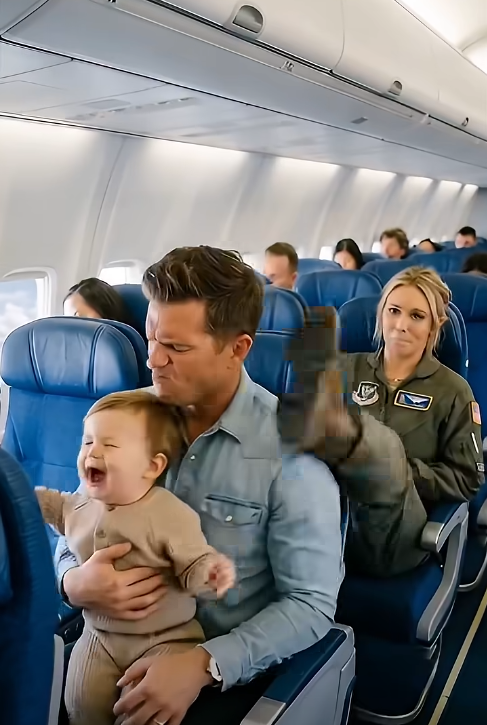
I shifted uncomfortably in my wide seat, gently adjusting the small, softly breathing bundle strapped securely to my chest. Toby, barely eight months old, was the absolute only anchor I had left in a world that had violently and irrevocably drifted off its axis. He exhaled a soft, milky breath against my collarbone, his tiny, perfectly formed fists curled tightly into the thick fabric of my charcoal sweater.
For over a agonizing year, my daily existence had been nothing but a series of hollow, agonizing echoes. My beautiful wife, Sarah, a highly decorated elite military intelligence officer, had vanished without a single trace during a highly classified, incredibly dangerous extraction mission over a hostile conflict zone seventeen months ago. I still vividly remember the exact sick, plunging feeling in my gut, the sudden inability to draw breath, when the two solemn officers in their immaculate dress uniforms had knocked heavily on my front door. Missing in Action. But the nightmare didn’t neatly end there. The universe, in its infinite cruelty, had one more miraculous, devastating twist to deliver to my doorstep.
Nine months after she disappeared—long past the agonizing point where my desperate hope had finally starved to death—the military knocked on my door once again. This time, they didn’t bring a tightly folded flag. They brought a sleeping newborn baby wrapped in a sterile hospital blanket.
A covert JSOC strike team had raided a subterranean black site in a desperate, midnight rescue operation. Deep in those concrete cells, they had miraculously found my wife. She had been secretly, terrifyingly pregnant when her chopper originally went down. She had been forced to give birth in the pitch dark, on a freezing concrete floor, surrounded entirely by enemies. And when the rescue team finally breached the heavily fortified compound, they were immediately and catastrophically outnumbered.
Sarah, severely weakened from the birth and months of unimaginable captivity, but running on the pure, feral, untamed adrenaline of a desperate mother, had taken a discarded enemy weapon and fiercely held the narrow corridor. She bravely provided the heavy covering fire necessary for a single, wounded operative to escape into the desert night with her newborn son. The entire compound collapsed under heavy enemy mortar fire mere minutes later. They never recovered her body from the smoking rubble. They only brought me Toby, a living, breathing testament to her ultimate sacrifice.
I was completely done waiting for ghosts to return. I was finally moving back to my quiet childhood home in the Pacific Northwest, retreating permanently from the beautiful house Sarah and I had built together, simply because every single shadow in those empty hallways loudly screamed her name. I was profoundly exhausted—the kind of soul-deep, crushing exhaustion that physically turns your bones to lead and makes simply keeping your eyes open feel like a monumental task.
The rhythmic, peaceful hum of the jet engines was suddenly and violently interrupted.
The entire cabin dropped drastically, plunging my stomach directly into my throat. The “Fasten Seatbelt” sign chimed with a sharp, terrifying ping, instantly illuminating the dark cabin in a harsh, warning red light. Severe, unpredictable turbulence. The heavy aircraft shuddered violently, loudly rattling the overhead bins as we hit a massive, invisible pocket of dead air. Toby whimpered loudly in his sleep, his small body tensing fearfully against mine. I instinctively wrapped both of my strong arms tightly around his fragile frame, curling my broad shoulders forward to shield his head from any falling luggage.
The violent, bone-rattling shaking lasted for ten agonizing, breathless minutes before the aircraft finally climbed above the dark storm system, smoothing out into a calm, steady glide. The seatbelt sign switched off with a soft click. The collective, shaky sigh of relief from the tense cabin was physically palpable.
But the shaking in my specific row did not stop.
Thud. Someone directly behind me had kicked the back of my leather seat. I frowned deeply, naturally assuming it was just a lingering, clumsy reaction to the severe turbulence, a frightened passenger merely shifting their stiff legs. I closed my heavy eyes, desperate for just ten uninterrupted minutes of sleep.
Thud. Thud. The physical vibrations traveled straight up my spine, a frantic, highly erratic drumming against the upholstery. It was causing Toby to stir again, his small face scrunching up as a low, unhappy wail began to build in his tiny chest. My protective grip tightened on his soft blanket. I had drained my depleted savings to pay for a ridiculously expensive business class ticket specifically to find a single moment of absolute peace, to let my orphaned son sleep without disruption.
I shifted my weight, a hot flash of parental annoyance flaring in my chest. I glanced down toward the floor. When the violent turbulence had hit, Toby’s small wooden teething ring had slipped from my lap and rolled under my seat, disappearing completely into the narrow, shadowed gap near the feet of the passenger behind me.
I sighed heavily, leaning awkwardly forward to reach my hand under the cold metal frame of my seat to quickly retrieve it.
As my searching fingers brushed the rough carpet, a hand suddenly slid forward from the dark shadows of row 4. I froze completely. My lungs instantly stopped working. It was a woman’s hand, severely gaunt and littered with fading bruises, but resting clearly on her scarred ring finger was a custom silver wedding band molded to look like intertwined ivy vines—the exact, unique ring I had placed on my dead wife’s finger five years ago.
A massive, overwhelming wave of profound nausea violently crashed over me, so intensely sudden that I almost dropped the wooden teething toy right back onto the carpet. My vision immediately tunneled, the soft amber edges of the airplane cabin blurring into a chaotic, dark static.
It’s absolutely impossible, my rational brain screamed at me, an icy, terrifying sweat breaking out rapidly across the back of my neck. It’s a severe grief hallucination. You are suffering from extreme sleep deprivation. You haven’t slept more than two consecutive hours in three entire days. You are completely losing your mind, David.
I slowly, mechanically pulled my upper body upright, my right hand shaking so violently that the wooden ring clattered loudly against the hard plastic armrest. I squeezed my eyes shut, praying for the phantom image to dissolve. But the rhythmic thudding against the back of my leather seat continued unabated. It wasn’t a malicious, purposeful kick from an annoyed traveler. I could feel the erratic, vibrating frequency of it through the seat cushion. It was a rapid, totally uncontrollable physical tremor. Someone was visibly shaking to the absolute point of a total physiological collapse right behind my head.
Toby, finally deeply disturbed by the constant, jerky movement and the sudden, terrifying spike in my own erratic heart rate, began to genuinely cry. It started as a frustrated fuss, then quickly escalated into a full-throated, desperate, echoing wail that sliced loudly through the quiet, civilized atmosphere of the business class cabin.
I physically couldn’t turn around. An invisible, suffocating, crushing weight pressed firmly against my sternum, pinning me to my seat. If I turned around right now and saw a total stranger who just happened to be wearing a vaguely similar piece of silver jewelry, the sheer, crushing disappointment would mathematically, literally kill whatever was left of my fractured heart.
With a wildly trembling index finger, I reached up to the overhead console and pressed the illuminated call button.
Seconds later, a young flight attendant approached silently down the carpeted aisle. Her polished gold name tag read Emily. She wore a highly practiced, porcelain mask of absolute corporate professionalism, her lips perfectly curved into a sympathetic, soothing customer-service smile designed to de-escalate any passenger tension.
“Is everything alright, sir?” Emily asked, keeping her tone in a very soothing, hushed register as her eyes darted briefly down to the screaming infant strapped to my chest.
“No,” I choked out miserably. My own voice sounded entirely foreign to my ears, completely stripped of moisture and incredibly fragile. I pointed a rigid, shaking finger directly over my shoulder. “The passenger back there. They are continuously kicking my seat. My son cannot sleep. Can you… can you please just see what’s wrong with her?”
Emily nodded gracefully, her smile never wavering. “Of course, sir. Please don’t worry. Let me just speak with her and sort this out.”
I watched Emily’s face incredibly closely as she took two confident steps past my row, politely angling her body to directly address the disruptive passenger sitting in Seat 4B.
What I witnessed in the next five seconds completely and utterly shattered my grasp on reality.
Emily opened her mouth to speak her practiced airline greeting, but the polite words instantly and visibly died in her throat. The pleasant, customer-service smile literally fell completely off her face, replaced by a mask of sheer terror. Every single drop of blood drained instantly from her cheeks, leaving her skin a stark, terrifying, ghostly white. Her eyes widened into massive saucers of absolute, unadulterated horror.
She didn’t say a single word to the passenger. She took a swift, highly panicked, stumbling step backward, her trembling hand flying up to tightly cover her mouth as if actively suppressing a loud scream. She looked back at me—a look of pure, paralyzing shock mixed with a profound, crushing sorrow that I will never forget—and then she practically sprinted backward toward the front galley, completely abandoning her beverage cart in the middle of the aisle.
My heart hammered against my ribs like a trapped, desperate bird trying to violently break through my sternum.
What in God’s name did she just see? The kicking against my seat abruptly stopped. It was immediately replaced by a sound that chilled me down to the very marrow of my bones. It was a low, guttural, ragged whimper. It was the undeniable sound of a terrified animal caught in a brutal steel trap, trying desperately to remain completely silent while enduring excruciating, unbearable pain.
I suddenly couldn’t breathe. The recycled air in the cabin felt incredibly thin, as if the emergency oxygen masks were about to deploy from the ceiling. I reached down and unbuckled my heavy seatbelt with a loud, definitive metallic click. I pulled Toby fiercely tightly against my chest, his loud cries still ringing sharply in my ears, and I finally forced myself to stand up.
Every single muscle in my trembling legs begged me to simply sit back down, to blindly accept the tragic reality the military had handed me, to not open this terrifying door. But the phantom behind me was audibly breathing. I placed my sweaty hand on the cool leather headrest to ground myself, and with my heart in my throat, I slowly turned my body around to look down at Seat 4B.
The world did not just significantly slow down; it utterly and completely stopped. The ambient, low hum of the jet engines faded into an absolute, suffocating nothingness, leaving only the deafening roar of my own heartbeat pounding against my eardrums.
Curled into a tight, incredibly defensive ball in the dark corner of the wide leather seat was my wife.
It was Sarah.
But the fragile woman I was staring at was a broken, devastating reflection of the fierce, radiant intelligence officer I had kissed goodbye on a rainy tarmac seventeen long months ago. She was severely emaciated, her collarbones protruding sharply beneath the filthy, oversized, and frayed olive-drab military jacket. Her hair, which had once been a brilliant cascade of bright gold, was chopped brutally short, matted with dirt and dried sweat. Her skin was a map of unimaginable suffering, pale and stretched far too tight over her cheekbones.
My breath hitched violently in my throat, feeling as though I had swallowed a handful of crushed glass. “Sarah?” I whispered. A single, scalding tear immediately broke free, burning a hot trail down my numb cheek. “Oh my god… Sarah, it’s you. You’re alive.”
I desperately expected her sunken eyes to widen with immediate joy. I expected a guttural sob of relief, a desperate, frantic reach for my hand. I expected the cinematic, tear-soaked reunion I had obsessively played in my head a million times over empty coffee cups at three in the morning.
Instead, she violently flinched.
She pressed her spine impossibly hard against the plastic window shade, her eyes completely feral and blown wide with sheer, unadulterated terror. But she wasn’t looking at my face. Her hollow, sunken eyes were completely, intensely fixated on the crying baby strapped tightly to my chest.
“Sarah… baby, it’s me. It’s David,” I sobbed, taking a cautious half-step toward her row, instinctively reaching out my free, trembling hand.
“No!” she shrieked.
The sound ripped viciously through the quiet, civilized cabin. It was raspy, destroyed from disuse, and filled with a primal agony. Passengers a few rows ahead immediately turned their heads in alarm, their reading lights flicking on.
Sarah’s chest heaved frantically. The severe turbulence hadn’t caused her to shake. The sight of her grieving husband hadn’t caused her to shake. It was a severe, catastrophic psychological panic attack. Her mind, deeply scarred by months of brutal sensory deprivation and unimaginable trauma, had completely fractured. She was not on a safe, commercial flight descending toward Seattle. In her shattered, traumatized mind, she was still trapped in the dark, suffocating bowels of the enemy prison compound.
She looked directly at my face, but she absolutely did not see her husband. She saw a phantom. She saw the enemy.
“Don’t take him again,” she muttered frantically, her scarred hands flying up to grip her own matted hair, pulling at the roots. Her voice vibrated with a terrifying madness that shattered my heart into a thousand irreparable pieces. “You said if I stayed, he could go! You promised me! Put the baby down! Don’t take him back into the dark!”
The sheer, raw agony in her delusion physically knocked the wind out of my lungs. The military psychiatrists had thoroughly debriefed me on severe PTSD, but absolutely nothing prepares a human being to look directly into the eyes of the person they love most in the universe and see absolutely zero recognition, only a primal, consuming fear.
“Sarah, please,” I begged, tears now freely streaming down my face, dripping onto Toby’s blanket. I kept my voice incredibly soft, trying not to startle her further. “It’s David. It’s Toby. We’re safe. You saved him, Sarah. You saved our son.”
She shook her head violently, her breath coming in rapid, dangerously shallow hyperventilations. “Liar,” she hissed, her muscles coiling as she slipped into a combative, defensive posture. “It’s a trick. It’s the lights again. You’re trying to trick me!”
She didn’t know who I was. And before I could take another cautious step to calm her deeply fractured mind, a terrifying, desperate maternal instinct overrode all of her physical exhaustion. With a guttural, blood-chilling scream, she lunged violently out of her seat, her skeletal hands forming tight claws, aiming directly for the baby strapped to my chest.
The narrow aisle of the aircraft instantly erupted into absolute, terrifying chaos.
Sarah’s unexpected forward momentum slammed me hard backward against the solid plastic bulkhead separating the cabin classes. I twisted my body aggressively to the left, instinctively shielding Toby’s fragile head from the impact and from her desperate, flailing hands.
“Sarah, stop! You’re going to hurt him!” I yelled, my voice echoing loudly in the enclosed space. I frantically tried to grab her wrists without applying any bruising force to her incredibly fragile, bird-like bones.
She fought me with the terrifying, uninhibited strength of a fiercely cornered animal. She was sobbing uncontrollably now, pleading rapidly in a chaotic mix of English and broken, desperate phrases of a foreign dialect I couldn’t comprehend. “Give him back! Let me die instead, just give him back to me!”
Two large male passengers from row five hastily unbuckled their seatbelts, rushing urgently down the aisle to intervene, naturally assuming I was being aggressively attacked by a deranged, violent passenger.
“Stay back!” I roared at them, my voice cracking with a terrifying, primal authority that stopped them dead in their tracks. “She is my wife! Do not touch her!”
The men froze instantly in the center of the aisle. The entire cabin suddenly fell into a heavy, suffocating silence. No one murmured a word. No one dared to pull out a smartphone to record. They simply watched, paralyzed, as a deeply traumatized veteran fought a brutal phantom war at thirty thousand feet, wrestling with the weeping husband who was desperately trying to save her from her own mind.
I finally managed to pin Sarah’s wrists gently but firmly against her own chest, slowly sliding my back down the bulkhead until I was kneeling directly on the carpeted floor of the aisle, pulling her down with me. She thrashed wildly against my grip, her eyes tightly squeezed shut, her breathing incredibly erratic and dangerously shallow. She was actively hyperventilating to the terrifying point of passing out.
Physical restraint was severely triggering her trauma. Logic, reasoning, and my desperate pleas could not even begin to penetrate the thick, dark, impenetrable walls of her psychological prison. I needed a completely different anchor. I needed to find something buried so incredibly deep in her subconscious that the enemy interrogators could not have possibly touched or corrupted it.
Toby, utterly terrified by the violent struggle and the loud voices, was screaming at the top of his lungs against my chest.
Taking a massive, terrifying risk, I completely let go of Sarah’s wrists. I raised both of my hands high in the air in a gesture of absolute, non-threatening surrender, sitting back heavily on my heels. She instantly scrambled backward on the floor, pressing her spine against the leather seats, curling her knees tightly to her chest, and glaring at me with the paranoid eyes of a hunted wolf.
I closed my eyes tightly, forcing myself to steady my own chaotic, ragged breathing. I ignored the intense stares of the fifty passengers. I ignored the young flight attendant weeping quietly by the galley curtain. I opened my eyes, looked directly into the hollow, terrified soul of my broken wife, and with a trembling, deeply emotional voice, I began to sing.
“Hush now, little bird, the storm is passing…” It was the exact melody she had hummed every single night while gently rubbing her flat belly, weeks before her final, ill-fated deployment.
Sarah flinched violently as the very first notes hit the quiet air. Her manic, gasping breathing visibly hitched.
“Close your weary eyes, the night is deep. The wind is cold, but love is lasting…” I kept my vocal register incredibly low and steady, forcing every single ounce of profound love and shared memory I possessed into the simple lullaby.
Her skeletal hands, which were violently gripping the metal seat frames, slowly began to loosen their white-knuckled grip. Her rapid, panicked blinking slowed down. The feral, completely terrified gloss over her sunken eyes began to visibly fracture, like incredibly thin winter ice cracking under the undeniable weight of a rising sun.
“I’ll stay right here, so you can sleep.”
The silence in the cabin became absolute. Sarah stared at me, her mouth parting slightly as the phantom walls of her prison cell finally began to dissolve. But as she slowly raised her heavily scarred, trembling right hand and reached out across the vast, terrifying empty space between us, I held my breath, absolutely paralyzed, not knowing if she was reaching out to finally embrace me, or preparing to strike me away.
I deliberately did not lunge forward to hug her. The military psychologists had warned me, with grave seriousness, that sudden physical confinement, even when born of profound love, could instantly trigger a catastrophic psychological relapse. I forced myself to stay perfectly still on the carpeted floor, letting her entirely bridge the terrifying gap at her own pace.
Her fingertips, heavily calloused, rough, and deeply scarred, gently brushed the soft fabric of my faded green sweater. Then, they moved upward with an agonizing slowness, tracing the familiar line of my jaw, feeling the undeniable warmth of my skin, desperately needing to physically confirm that I wasn’t just another incredibly cruel, fleeting mirage conjured by a dying, starved brain in a pitch-black cell.
A single, monumental, gut-wrenching sob broke violently from the very bottom of her throat. She slid completely forward off the base of the seat and collapsed entirely onto her knees in the narrow aisle, directly in front of me. She buried her tear-soaked face deep into the crook of my neck, her thin, fragile arms wrapping with a desperate, crushing intensity around my shoulders.
I finally wrapped my own arms around her shaking, emaciated frame. I held her fiercely as she wept loudly—not the silent, heavily conditioned, and pained whimpers of a terrified prisoner trying to remain hidden, but the loud, messy, beautifully human tears of a woman who had just realized, down to her very marrow, that she was finally, truly free.
There was absolutely no cinematic applause from the surrounding cabin. Real life, especially trauma, is not a Hollywood movie. Instead, there was a sacred, incredibly profound, and deeply respectful silence. Complete strangers quietly wiped their own streaming eyes and deliberately looked away out the windows, giving our deeply wounded family the supreme dignity of absolute privacy in a very public space.
After several long, highly emotional minutes, Sarah pulled back slightly, her bloodshot, swollen eyes dropping slowly to the moving bundle strapped securely to my chest. Toby was wide awake now, his tears dried, staring at this strange, weeping woman with a quiet, innocent curiosity.
She raised a violently trembling hand. For a terrifying fraction of a second, I thought the blind panic might return. But she didn’t grab him aggressively. She gently, with the utmost reverence, rested her scarred palm against his warm, incredibly soft, perfectly round cheek.
“He has your eyes,” she whispered, her voice barely a breath. A broken, exhausted, but breathtakingly beautiful smile finally graced her chapped lips. She had willingly traded her physical health, her sanity, and seventeen agonizing months of her existence in absolute, unimaginable hell just so this tiny, fragile chest could steadily rise and fall with breath.
“He has your courage,” I replied immediately, gently covering her scarred, shaking hand with my own, pressing it firmly against our son’s cheek.
As the heavy aircraft finally began its slow, steady, and inevitable descent toward the glowing city lights of Seattle below, we sat closely side by side in row 4. I securely held her hand the entire time, my thumb continuously stroking the silver ivy vines of her wedding ring.
Our deeply complex story didn’t magically resolve the moment the rubber tires touched the dark tarmac. The terrifying psychological ghosts of that subterranean black site did not simply stay contained on the airplane. I knew there would be years of intense, exhausting psychological therapy ahead of us. There would undoubtedly be dark nights where the sudden, loud sound of thunder would send her frantically hiding in the darkest corner of our closet. There would be incredibly hard days when the trauma would feel like an impossibly heavy, iron anchor desperately trying to drag her back down into the suffocating dark.
But as the massive thrust reversers roared to life, safely slowing the heavy aircraft down on the runway, Sarah rested her tired, incredibly heavy head firmly against my shoulder. Toby was fast asleep, sandwiched safely and warmly between us.
The vast, intimidating sky, which for seventeen agonizing months had been a cruel, impenetrable barrier that had stolen my brilliant wife away, was no longer my worst enemy. It was simply the long, turbulent, beautifully unpredictable road that had finally, miraculously, brought my shattered family back home.
If you want more stories like this, or if you’d like to share your thoughts about what you would have done in my situation, I’d love to hear from you. Your perspective helps these stories reach more people, so don’t be shy about commenting or sharing.