By the time I turned my SUV onto Maple Hollow Drive, my hands were shaking so violently I could barely grip the steering wheel. The rain from the morning’s storm had left the suburban streets slick and dangerous, but I didn’t care. I took the final corner entirely too fast, the tires hydroplaning for a terrifying second before gripping the asphalt again.
The phone call had lasted exactly nine seconds.
It wasn’t an emergency room doctor. It wasn’t a neighbor. And, most horrifyingly, it wasn’t my seven-year-old daughter.
It was a woman’s voice. Cold. Urgent. Unapologetic.
“Mr. Sterling, come home right now. Please. It’s about Chloe.”
Then, the line had gone dead.
I had driven the ten miles from my downtown office like a man actively chased by hellfire. I ran two red lights. I cut off a delivery truck. My mind, usually so analytical and composed, was suddenly filling every agonizing silence with catastrophic images.
Chloe on the floor. Chloe hurt. Chloe crying out for me, unable to reach the phone.
Chloe, my sweet, fragile little girl. Trapped in that heavy, motorized wheelchair she had desperately needed ever since the accident three years ago. The accident that had shattered my world and taken her mother.
The sprawling, familiar silhouette of my house finally came into view.
It looked peaceful. Absurdly, terrifyingly peaceful.
The silver sedan belonging to the new caregiver sat neatly in the driveway. The living room curtains were drawn open, revealing the warm glow of a lamp inside. The front lawn was bright, vibrant green from the recent rain. Everything looked normal enough to be utterly cruel.
I slammed the brakes, throwing the car into park before it had even fully stopped moving. I unbuckled my seatbelt, my heart hammering a frantic rhythm against my ribs.
Then, I saw the water.
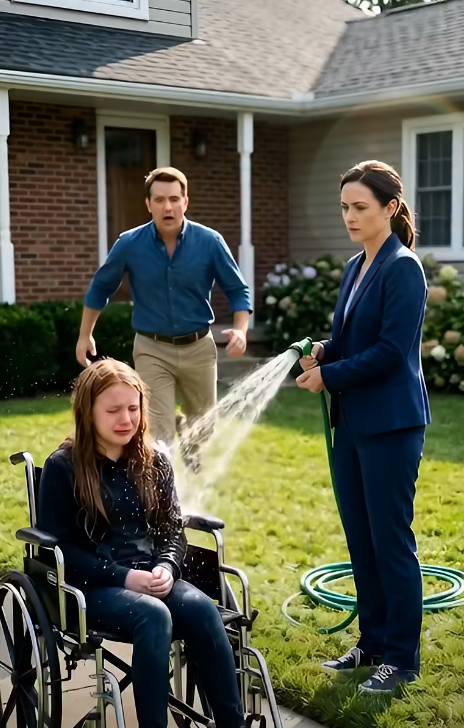
A thick, aggressive stream of water from the garden hose was blasting directly into the center of the front yard.
For one impossible second, my brain refused to process the scene unfolding in front of my own house. I could not move. I could not breathe.
My daughter, Chloe, sat in the middle of the wet grass in her wheelchair. She was soaked from head to toe. Her pale blonde hair, the exact shade as her mother’s, clung to her cheeks in wet, heavy strands. Her delicate white summer dress sagged heavily against her tiny, frail body. Her knuckles were bone-white as she gripped the armrests of the wheelchair, her eyes squeezed shut as the cold water hit her face.
Standing directly behind her, holding the brass nozzle of the hose, was Sarah, the new caregiver my sister had recently hired.
Sarah looked completely calm. She looked steady. She looked entirely unapologetic.
A primal, blinding rage ignited in my chest.
I threw the car door open and hit the wet grass running.
“What the hell are you doing?!” I roared, my voice tearing through the quiet suburban street.
Sarah turned her head toward me. She didn’t drop the hose. She didn’t flinch. She didn’t look like a woman caught abusing a paralyzed child.
“I’m washing your daughter,” Sarah replied.
The sentence struck me harder than a physical blow. The absolute, clinical detachment in her voice made the blood rush to my ears.
I charged across the lawn, my dress shoes slipping on the wet grass, and violently ripped the heavy green hose from her hands. Water whipped sideways, spraying the porch, the rosebushes, and Sarah’s skirt. I threw the nozzle to the ground.
“Have you completely lost your mind?!” I shouted, positioning myself between her and the wheelchair. “She’s paralyzed! She can’t defend herself!”
Sarah didn’t step back. Her dark eyes flicked slowly from me to the shivering girl in the wheelchair.
“Can’t she?” Sarah asked.
The words were small. Barely louder than the water still pooling on the driveway.
But they changed the air pressure in the yard.
I turned my back on the caregiver, dropping to my knees in the wet grass, desperate to gather my terrified daughter into my arms.
“Baby,” I whispered, my voice breaking. “I’m here. Daddy’s here. It’s okay.”
I reached out to pull her to my chest, but Chloe didn’t look at me. She didn’t reach for me.
She was staring dead ahead at Sarah. Not with confusion. Not with the tearful relief of a rescued child.
Chloe was looking at the caregiver with absolute, unadulterated terror.
“Chloe?” I said softly, my hands hovering over her wet shoulders. “Honey, look at me.”
Her small lips trembled violently. Her breathing was shallow and fast.
Sarah folded her arms across her chest. “Tell him, Chloe.”
Chloe’s tiny face crumpled, tears finally mixing with the hose water on her cheeks. “Please,” she whimpered, her voice shaking. “Please don’t.”
My anger faltered, replaced by a sudden, chilling confusion. “What is going on here?” I demanded, looking between the two of them. “Sarah, what did you do to her?”
Sarah took one slow, deliberate step back, giving the wheelchair space.
“Stand up, Chloe,” Sarah commanded.
The world around me went dead silent. The distant hum of traffic vanished. The rustle of the wet oak trees stopped.
I stared up at the caregiver as if she had suddenly started speaking a dead language.
“She can’t,” I said, my voice barely a whisper. “You know she can’t.”
Sarah’s eyes locked onto mine, hard and relentless. “Yes, Mr. Sterling. She can.”
Chloe began to sob then. It wasn’t a loud, chaotic wail. It wasn’t the sound of a child in physical pain. It was a deep, guttural, heart-wrenching sound—the sound of someone watching the absolute end of a massive lie approach.
Her small fingers tightened around the armrests.
Her thin shoulders shifted.
Her body leaned forward.
And then, shaking violently, my paralyzed seven-year-old daughter pushed herself up from the wheelchair.
I stopped breathing entirely.
My heart felt like a cold stone dropping into the pit of my stomach. I knelt in the wet grass, paralyzed by the impossibility of what I was witnessing.
Water streamed from Chloe’s delicate sleeves. Her thin knees wobbled uncontrollably. Her small, bare feet pressed firmly into the soaked lawn.
She stood.
She wasn’t standing well. She wasn’t strong. But she was standing. Entirely unassisted.
“No,” I whispered, the word scraping against my throat. “No, that’s… that’s not possible.”
Sarah looked down at me with cold, exhausted eyes. “That’s exactly what I thought the first time I saw her walk down your hallway.”
I stumbled backward, landing hard on the wet grass, unable to tear my eyes away from my daughter.
Three years.
Three agonizing years of neurologists, specialists, and excruciating physical therapy sessions that ended in tears. Three years of custom leg braces, accessible bathroom renovations, and nights spent sitting beside her bed while she sobbed, wishing she could just run in the backyard like the other kids.
Three years of carrying her up the stairs when the stairlift broke.
Three years of crushing, suffocating guilt. Because the accident had happened on my watch.
It was a rainy November night. A massive delivery truck had hydroplaned through a red light at an intersection. I remembered the blinding headlights, the sound of crunching metal, the shattering glass everywhere. I remembered Chloe screaming from the backseat.
My wife, Evelyn, the absolute love of my life, had died before the ambulance even arrived.
Chloe had survived. The doctors said her spinal cord was bruised, and the trauma had left her paralyzed from the waist down. I had spent every single day since that night trying to make her survival enough for both of us.
“Chloe,” I gasped, barely able to form the word around the lump in my throat. “How? When did this happen?”
Chloe’s legs finally gave out. She sank back heavily into the leather seat of the wheelchair, burying her face in her wet hands.
“Daddy, I’m so sorry!” she wailed, her voice thick with panic. “I’m sorry! I’m sorry!”
That was the exact moment I saw the terrifying shape of the truth. Not all of it. But just enough to make me physically sick.
Sarah walked over to the front porch steps, picked up a small, black digital tablet, and walked back to me. She tapped the screen once, then held it out.
I didn’t take it at first. My hands were shaking too badly. I was terrified of what it would show.
“Watch it,” Sarah said, her voice softer now, lacking the previous edge.
I took the tablet. The video began in silence.
It was security footage from the hallway camera inside my house, dated two days earlier. It showed Chloe alone in the corridor. Her wheelchair sat parked near the bottom of the staircase.
Then, on the screen, my paralyzed daughter stood up.
She moved carefully, checking her surroundings, but her movements were smooth. She walked into the kitchen, out of frame for a few seconds, then walked back holding a juice box. She sat back down in the wheelchair, perfectly positioning her lifeless-looking legs on the footrests.
My stomach violently turned. I felt bile rise in my throat.
Sarah swiped the screen. Another clip.
Chloe at midnight, walking steadily to the living room to retrieve a dropped toy.
Another swipe.
Chloe standing beside the large bay window in the living room, actively practicing a pronounced limp before quickly sitting back down in the chair just as the headlights of my SUV pulled into the driveway.
Every single clip felt like a jagged knife twisting in my ribs. I had been living in a meticulously curated delusion.
My eyes burned with unshed tears. “Why?” I whispered, looking up at Sarah. “Why would she do this? Why would a child fake this?”
Chloe cried harder, curling into a tight ball in the chair. “I didn’t mean to, Daddy! I didn’t want to!”
Sarah’s jaw tightened. She reached out and gently took the tablet from my trembling hands.
“That’s not all, Mr. Sterling,” Sarah said grimly.
I stared at her, wiping the rain and tears from my face. “What do you mean that’s not all? What else could there possibly be?”
Sarah hesitated for the very first time since I had arrived. The defiant, clinical mask on her face finally cracked, revealing something profoundly unsettling beneath it.
It was grief.
“I was hired by your sister to care for Chloe,” Sarah said quietly. “But I quickly realized I was also hired to watch her. To monitor her.”
“Monitor her? Why?”
Sarah didn’t answer. Her dark eyes simply moved away from me, looking past my shoulder toward the house.
I followed her gaze.
Through the large, rain-streaked front window of the living room, a shadow shifted. Someone was standing inside, watching us.
It was my older sister. Victoria.
My blood ran absolutely cold. Victoria didn’t live with us. She was supposed to be at her corporate office downtown.
The heavy oak front door opened slowly. Victoria stepped out onto the porch, wearing a pristine cream silk blouse and a face full of perfectly practiced, theatrical shock.
“Ethan? Good god, what is happening out here?” Victoria gasped, rushing down the steps. “Why is Chloe soaking wet? Sarah, what have you done to my niece?!”
Sarah let out a single, humorless laugh. “You can stop performing, Victoria. The show is over.”
Victoria stopped in her tracks, her eyes narrowing slightly before she turned to me, her expression melting into deep concern. “Ethan, please tell me you’re not going to believe the words of a deranged nanny over your own family?”
I could not answer. My brain was misfiring.
My daughter sat soaked, terrified, and trembling in front of me, having just revealed a three-year medical lie. My sister stood perfectly dry and composed in the doorway.
And suddenly, a flood of memories hit me with the force of a freight train. Every single piece of paper Victoria had ever brought to me over the last three years.
Insurance payout paperwork.
Medical appeals.
Disability trust fund documents.
“Just sign here, Ethan. You’re too exhausted to read it all. Let me handle the heavy lifting. It’s just to protect Chloe’s future.”
I remembered the massive, high-profile charity gala Victoria had insisted on hosting in Chloe’s name last year. The ‘Chloe Sterling Foundation.’ The massive corporate donations. The glowing newspaper articles about Victoria’s tireless advocacy.
Poor little Chloe Sterling, the brave, paralyzed girl, and her devoted, wealthy aunt who never stopped fighting for her.
I turned slowly, rising from the wet grass to face my sister.
“Victoria,” I said, my voice dangerously low. “What did you do?”
Victoria’s mouth tightened into a thin, unyielding line. She stood tall on the porch, her posture radiating defensive indignation.
“Everything I did, Ethan, I did to protect this family,” she stated, her voice smooth and practiced. “You were falling apart after Evelyn died. You were barely functioning. I stepped in to secure Chloe’s financial future. The insurance payouts, the foundation… it was all necessary.”
Sarah took a step forward, closing the distance between us. “She knew Chloe could walk, Mr. Sterling. She’s known for over two years.”
I felt the wet lawn physically tilt beneath my feet. The air was suddenly too thin to breathe. “You knew?” I choked out. “You watched me carry her up those stairs every single night, and you knew?”
Victoria’s eyes flashed with sudden, venomous anger. She pointed a manicured finger at Sarah. “That child was emotionally unstable after the crash! She needed structure. She needed a narrative that kept the funding secure until she was an adult!”
“Structure?!” Sarah snapped, her professional composure finally breaking into pure rage. “You want to talk about structure, Victoria? Tell him what you told that little girl! Tell him how you kept her in that chair!”
Chloe let out a broken, agonizing sound, hiding her face in her hands.
I turned back to my daughter, dropping to my knees again. I gently pulled her wet hands away from her face. “Chloe. Baby, look at me. Please. What did Aunt Victoria tell you?”
Chloe’s tiny face collapsed in absolute misery. She looked at me, her blue eyes—so hauntingly like Evelyn’s—brimming with a terror that no seven-year-old should ever possess.
“She… she said Mommy died because I was bad,” Chloe whispered, her voice shaking so badly I could barely hear the words over the wind. “She said the crash happened because I was crying in the backseat and distracted you.”
My heart physically split open.
“She said if I got better,” Chloe sobbed, “if I stood up and walked, you would finally have time to remember that I was the reason Mommy was gone. She said you would leave me.”
“No,” I gasped, the word tearing out of my throat. “No, baby, god, no.”
Chloe shook her head wildly, the wet hair slapping against her cheeks. “She said you only stayed with me because I was broken and needed help! If I was fixed… you wouldn’t love me anymore!”
Victoria stepped down off the porch, her face flushed red. “She was four years old when the accident happened, Ethan! She fundamentally misunderstood a conversation we had about her physical therapy! This nanny is manipulating her!”
Sarah didn’t argue. She simply raised the black tablet again. “Then explain your own recordings, Victoria.”
Victoria froze. The color instantly drained from her perfectly powdered face.
Sarah tapped a new file. The volume on the tablet was turned up to maximum.
Victoria’s voice played from the small speaker. It wasn’t her smooth, corporate tone. It was low, sharp, and terrifyingly cruel.
“You listen to me very carefully, Chloe. If your father ever catches you walking, everything changes. The money stops. The foundation closes. And then, he’ll finally have the time to realize you killed his wife. Do you want him to hate you? Sit down in that chair and do not move.”
I closed my eyes.
A sound came out of me that did not feel human. It was a guttural, agonizing sound of a father realizing his child had been living in a psychological torture chamber designed by his own flesh and blood.
“Daddy?” Chloe whimpered, reaching out a trembling hand toward me.
I snapped my eyes open. I grabbed her small, wet hands and held them tightly against my chest.
“Look at me, Chloe,” I commanded gently.
She sniffled, meeting my gaze.
“You did not kill your mother,” I said, my voice thick with emotion but absolute in its certainty. “The crash was an accident. It was a wet road. It was no one’s fault. Do you hear me?”
Chloe nodded slowly, more tears spilling over her lashes.
“And I have never, ever loved you because you were broken,” I continued, pulling her forward. “I loved you because you are mine. I will love you if you walk, if you run, or if you never leave that chair again. You are my entire world.”
For the first time in three years, the rigid, terrified tension left my daughter’s body. She leaned forward and collapsed completely into my arms.
I held her fiercely against my chest, feeling her soaked dress, her trembling bones, her rapid heartbeat. I didn’t care about the muddy water soaking into my suit. I didn’t care about the neighbors who were beginning to gather on the sidewalks, watching the spectacle.
I only cared that my daughter was finally shaking off the weight of an adult’s monstrous lie.
“I’m calling my lawyers,” Victoria hissed, turning sharply on her heel to retreat into the house.
Sarah stepped smoothly in front of the porch steps, physically blocking my sister’s path.
“Don’t,” Sarah warned.
Victoria’s face twisted into an ugly sneer. “Move out of my way, you pathetic hired help.”
In the distance, the sharp, rising wail of police sirens cut through the suburban quiet.
I looked up at Sarah in surprise.
She swallowed hard, her eyes fixed on Victoria. “I called them ten minutes before I called you, Mr. Sterling.”
I understood then. I understood exactly why Sarah had used the garden hose.
It hadn’t been cruelty. It had been an act of desperate, calculated salvation. She needed a physical shock strong enough to break through Chloe’s ingrained terror. She needed a scene chaotic and impossible for me to ignore or dismiss.
She needed to force the ugly, rotting truth into the blazing daylight before Victoria could bury it in the dark again.
The police arrived in a chaotic rush of flashing blue and red lights and the screech of wet tires on the asphalt. Three squad cars boxed in my driveway.
Victoria immediately went on the offensive. She shouted. She denied everything. She pointed a manicured finger at Sarah, accusing the caregiver of child abuse for spraying a disabled girl with a hose. She pointed at me, accusing me of hysterical grief-induced paranoia. She even accused my dead wife of leaving the family financially unstable, justifying her “creative” fundraising.
But the black tablet spoke far louder than Victoria’s lies.
The audio recordings were damning. But Sarah hadn’t just stopped at recording conversations.
When the lead detective began taking statements, Sarah handed over a thick manila folder she had retrieved from her car. Inside were bank records she had meticulously photographed from Victoria’s unlocked home office while my sister was out.
There were massive, unauthorized withdrawals from the Chloe Sterling Foundation. Insurance payouts funneled into offshore LLCs.
And, most devastatingly, there were hidden medical reports from two years earlier.
Reports from a highly specialized pediatric neurologist that Victoria had never shown me. The documents clearly stated that Chloe’s paralysis was likely psychological—a trauma response known as conversion disorder—and not a permanent spinal injury. The doctor had strongly recommended intensive psychiatric therapy.
Victoria had canceled all future appointments with that doctor and found a new, highly paid physician who agreed to sign off on the permanent disability status required for the massive insurance settlements.
For two entire years, she had monetized my daughter’s trauma.
I sat on the damp grass with Chloe securely wrapped in my suit jacket, watching as two officers placed my sister in handcuffs.
As they led Victoria past us toward the squad car, she stopped. She looked down at Chloe, the mask of the loving aunt completely gone, replaced by pure, unadulterated hatred.
“You ruined everything, you stupid little brat,” Victoria spat.
Chloe flinched hard, burying her face in my shoulder.
I stood up slowly, keeping Chloe safely behind me. For the first time in three years, the suffocating fog of grief and guilt lifted, leaving only cold, protective steel in my veins.
“No, Victoria,” I said, my voice echoing clearly over the crackle of the police radios. “She didn’t ruin anything. She survived you.”
Victoria’s face emptied of all expression. She had nothing left to say. The officers pushed her into the back of the cruiser and slammed the door.
The yard slowly quieted down. The flashing lights pulled away, leaving only the fading hum of sirens. The nosy neighbors retreated into their homes, closing their blinds. The green garden hose lay curled in the grass like a dead, venomous snake. Water still ran down the concrete driveway in thin, silver threads.
Sarah stood apart from us near the porch, her arms wrapped tightly around herself, shivering slightly in the cool breeze.
I walked over to her, carrying Chloe in my arms.
“I thought you were hurting her,” I said quietly.
Sarah looked down at the grass. “I know. It was a massive risk. I hated doing it.”
“I almost attacked you,” I admitted, shame coloring my words.
“I know,” she repeated.
My throat tightened. I looked at the woman who had just detonated a bomb in my life, only to save my daughter from the rubble. “Why? Why did you care enough to risk going to jail? Why did you dig through her files?”
Sarah’s face changed. The professional, cold detachment faded completely, and something unbearably sad took its place.
She reached into the pocket of her wet skirt and pulled out a small, folded, laminated photograph. She handed it to me.
I took it. It was an old Polaroid.
A much younger Sarah stood smiling brightly. And standing right beside her, laughing with her head thrown back… was Evelyn. My wife.
They were both wearing matching blue hospital volunteer badges.
I stared at the picture, the world stopping once again.
“You… you knew my wife?” I asked, my voice barely a breath.
Sarah nodded, thick tears finally pooling in her dark eyes. “Evelyn was my older sister, Ethan.”
My lips parted in absolute shock. “That’s not possible. Evelyn told me she was an only child. She said she had no family left.”
“She had me,” Sarah whispered, a tear slipping down her cheek. “But Victoria made absolutely sure you never knew I existed.”
“I don’t understand,” I stammered.
“Evelyn found out about Victoria’s early financial embezzlements from your family trust shortly after you two got married,” Sarah explained softly. “Victoria threatened to destroy Evelyn’s reputation, to frame her for the missing money. Evelyn distanced herself from me to protect me from your sister’s fallout. She was gathering evidence. She was trying to expose Victoria before the accident happened.”
I looked down at the photograph again. Evelyn’s radiant smile. Evelyn’s arm wrapped securely around Sarah’s shoulders. The missing piece of the puzzle I never knew I was looking for.
Then, Sarah reached into her other pocket and handed me one final, sealed envelope.
“Evelyn gave this to me the week before she died,” Sarah said, her voice breaking. “She told me to hide it. She said if anything ever happened to her, I shouldn’t give it to you until I was absolutely sure the threat was gone.”
I took the envelope with shaking hands.
It was Evelyn’s handwriting. The elegant, looping cursive I hadn’t seen in three years.
I carefully broke the seal and pulled out the single sheet of stationary.
My dearest Ethan,
If you are reading this, then I failed to tell you the truth in time. Victoria is not who you think she is. She has been stealing from the trust for years, and she knows I have the proof. Please, whatever happens, protect Chloe from her. And please forgive me for being too afraid to speak up sooner.
At the very bottom of the page, separated by a space, one final line waited for me like a warm hand reaching across the impossible void of death.
Tell our beautiful daughter that she was never the reason I died. She was the only reason I fought so hard to live.
I broke.
Not loudly. Not theatrically. I simply folded the paper against my chest and wept silently, the crushing weight of three years of manufactured guilt finally washing away in the rain.
Chloe reached out with wet fingertips and gently touched the folded letter.
“Mommy wrote that?” she asked in a tiny voice.
I nodded, wiping my eyes. “Yes, baby. She wrote it for you.”
The little girl stared at the paper as if it were pure sunlight captured in ink.
Then, slowly, deliberately, Chloe shifted forward in my arms.
I set her down gently, keeping my hands hovering near her waist, ready to catch her if she fell. Her small, bare feet touched the wet grass.
Chloe stood up.
She took one shaky step.
Then another.
Sarah covered her mouth with her hands, crying silently.
I fell to my knees, tears blinding my vision, holding my arms wide open.
Chloe walked three wobbly, miraculous steps directly into her father’s arms.
And for the very first time since the night our world ended, the heavy metal wheelchair sitting behind her on the lawn remained completely, beautifully empty.
If you want more stories like this, or if you’d like to share your thoughts about what you would have done in my situation, I’d love to hear from you. Your perspective helps these stories reach more people, so don’t be shy about commenting or sharing.